Reviewed · ANGKOR WAT TOURS
Full Day Temples Explorer – Small Group
Angkor Wat is only the opening act here. This eight-hour temple circuit also takes you through Angkor Thom, the many-faced Bayon, and jungle-wrapped Ta Prohm, giving you a strong first look at the Angkor complex without trying to cover every ruin in one frantic day.
I like the small-group format, with an air-conditioned minivan, hotel pickup, bottled water, and time to ask questions. I also like the guides named in the feedback, including Noy and Sok, who explain both temple details and Cambodian history. The main drawback is the busy schedule: three hours at Angkor Wat, one and a half hours at Bayon, lunch, and Ta Prohm leave little room for lingering.
Key points before you book
- Angkor Wat gets three hours, enough for a meaningful visit rather than a quick photo stop.
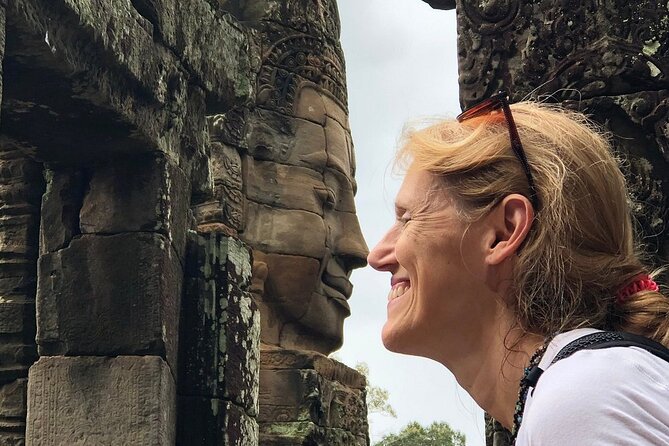
- Bayon brings the famous stone faces, with about 90 minutes to explore its inner levels.
- Ta Prohm follows lunch, when its trees, roots, and ruined corridors make the strongest visual impression.
- The group is designed to stay small, although the stated maximum varies between 10 and 15 people.
- The $19 price is only the tour fee, since the Angkor temple pass costs $37 per person.
- Hotel pickup and drop-off in Siem Reap City make this useful if you want a simple day without arranging transport.
What this Angkor day covers
This tour follows a sensible route through the best-known parts of the Angkor complex. You begin at Angkor Wat, continue through the southern entrance to Angkor Thom, visit Bayon and the nearby terraces, stop for lunch near Srah Srang, then finish at Ta Prohm.
That order gives you the grandest monument first, the sculpted faces and royal city next, and the atmospheric temple ruins later in the day. It also keeps the day focused. You are not being driven from one distant corner of the complex to another just to collect temple names.
The tour begins at about 8:00 am with pickup from your Siem Reap City hotel. Transport is by air-conditioned vehicle, a practical benefit in Cambodia’s heat. The exact group size needs a little clarification: the tour is presented as a small group of up to 10, while the additional information gives a maximum of 15. If group size matters greatly to you, ask the operator to confirm the number before booking.
More Angkor Wat tours in Siem Reap:
- Angkor Wat Sunrise or Sunset Tour with Guide from Siem Reap
★ 5.0 · 12,109 reviews - Siem Reap: Angkor Wat: Small-Group Sunrise or Sunset Tour
★ 5.0 · 9,444 reviews - Siem Reap: Angkor Wat 2-Day Tour with Sunrise and Sunset
★ 4.9 · 4,429 reviews
Angkor Wat in a three-hour opening visit
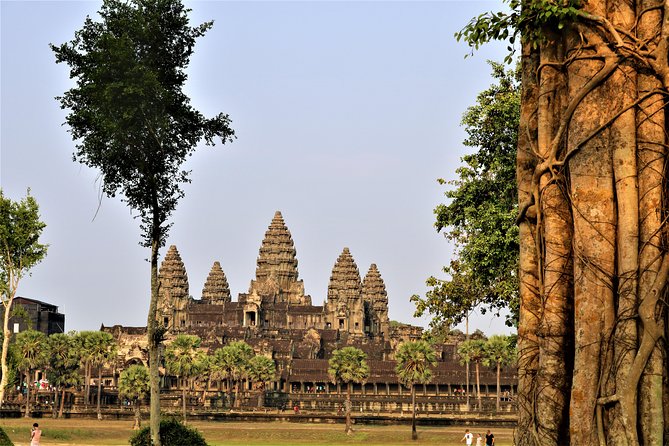
Angkor Wat receives the largest block of time, about three hours. That is appropriate. The complex is vast, and rushing through the outer galleries, courtyards, towers, and reliefs would turn one of the world’s great monuments into a checklist stop.
Your guide introduces Angkor Wat as the world’s largest religious monument and provides context as you approach the ruins. That background matters here because the scale can be hard to grasp on your own. You are not simply looking at towers in the distance. You are entering a carefully planned temple complex built for religious and royal purposes.
The long visit lets you move beyond the classic front view. You can examine the carved galleries, see the central towers from different angles, and give your guide time to explain details that are easy to miss. Feedback about the guides repeatedly points to useful explanations about Cambodia as well as the temples. Guides such as Noy and Sok are specifically praised for making the country’s history and culture easier to understand.
There is a practical cost to this first stop. Three hours at Angkor Wat can feel long if you mainly want photographs or have already visited the temple. For a first visit, however, the time is well chosen. Wear clothing that covers your shoulders and knees, use the supplied water, and expect plenty of walking across uneven surfaces.
The temple pass is not included. You pay $37 directly at the site, so the real basic cost is $56 per person before any lunch expense. That is important when comparing this tour with other Angkor options.
Entering Angkor Thom through the South Gate
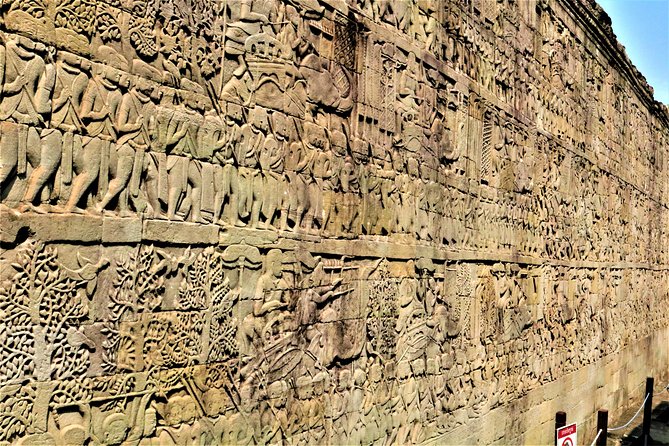
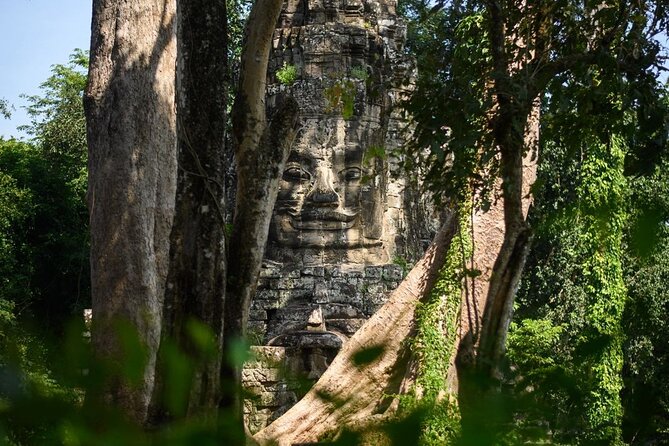
The stop at Angkor Thom’s South Gate lasts about 30 minutes. The gate is known for its stone figures lining the approach, with 54 gods on one side and 54 demons on the other. The arrangement gives you an immediate sense of Khmer religious imagery before you even reach the city’s main temple.
Thirty minutes is enough for a look, photographs, and an explanation from the guide. It is not enough for a long study of every figure or for a full walk around the fortified city. Think of this as an introduction to Angkor Thom rather than a complete visit to the entire royal city.
The stop is valuable because it connects the temples to a larger plan. Angkor Thom was not just a collection of religious buildings. It was a fortified city and a capital of the Khmer Empire. The South Gate makes that scale visible in a quick, manageable way.
Bayon and its famous stone faces
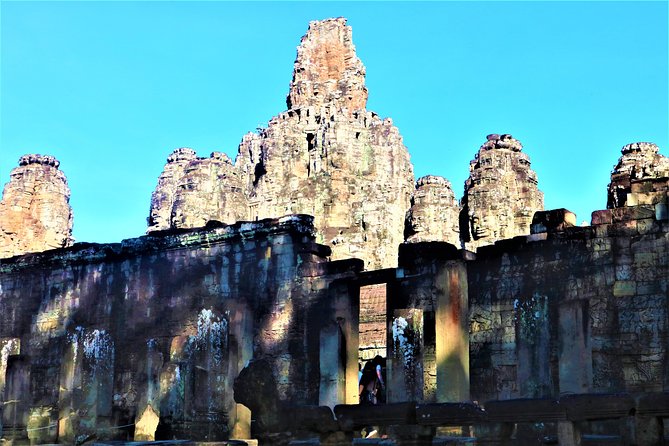
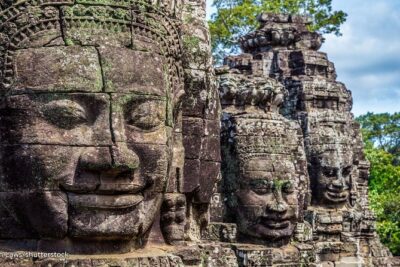
Bayon receives about 90 minutes, which gives you time to appreciate its unusual design. The temple’s central towers carry enormous carved faces, and the effect changes as you move through its narrow passages and upper levels.
This is a different experience from Angkor Wat. Angkor Wat feels ordered and monumental, while Bayon can feel compressed, puzzling, and full of surprises. Faces appear from different angles, sometimes partly hidden by towers or walls. A guide helps you make sense of the plan instead of treating the temple as a maze of stones.
The tour also passes the Terrace of the Leper King and the Terrace of the Elephants. These are not listed as full-length stops, so you should expect to see them from the route rather than spend a long time exploring them. That is a reasonable tradeoff in a one-day circuit, though you may want a separate Angkor Thom visit if these terraces are a priority.
The guide’s role is especially useful at Bayon. The carved faces are instantly recognizable, but the surrounding details require more patience. The strongest feedback about this tour points to guides who offer more than basic facts and explain the wider story of Cambodia, its culture, and its past.
More full-day trips in Siem Reap:
- Siem Reap: Full-Day Angkor Wat Guided Tour with Sunset
★ 4.9 · 3,803 reviews - Full-Day Angkor Wat Sunrise Private Tour with Guide from Siem Reap
★ 5.0 · 2,920 reviews - Siem Reap: Angkor Wat Sunrise and Full-Day Sightseeing Tour
★ 4.9 · 2,828 reviews - Full-Day Guided Sunset Tour of Angkor Wat
★ 5.0 · 1,507 reviews
Lunch near Srah Srang
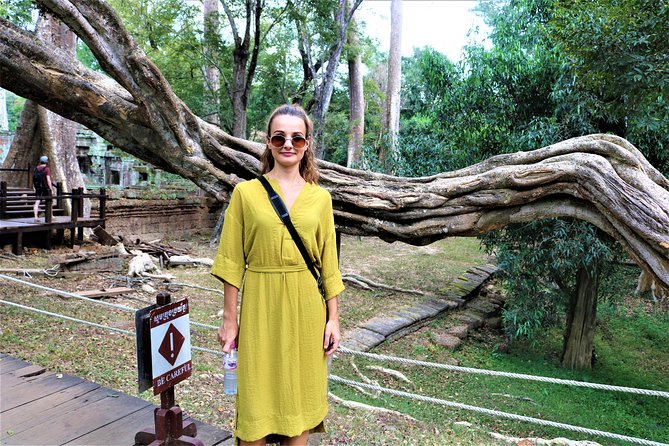
The midday stop is at Srah Srang, with about an hour set aside for lunch and rest. Srah Srang is one of the Angkor area’s reservoirs, and the stop breaks up the walking before the final temple.
The food arrangement needs careful attention. The itinerary describes lunch at a local Khmer restaurant and says lunch is included in that section. The formal inclusions, however, do not include a meal, and the exclusions say lunch is available at your own choice. Treat lunch as not included unless the operator confirms otherwise. Budget for it separately and ask what the stop covers before departure.
An hour is a useful pause. You can eat, cool down, refill your energy, and return to the temples without feeling that the day is one continuous march. The tour includes mineral water, but you may still want extra water for Cambodia’s heat.
Because lunch is at a local restaurant, this stop may be less polished than a hotel meal. That is part of the practical appeal for some people, since you are eating near the temple circuit rather than losing time returning to Siem Reap. If you have dietary needs, confirm your options in advance because no special meal information is provided.
Ta Prohm after the midday break
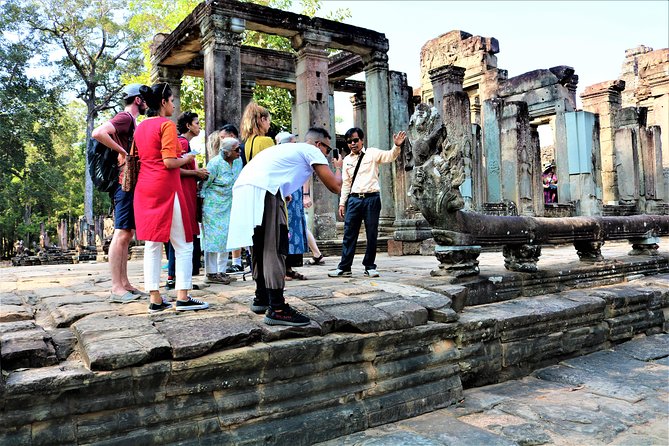
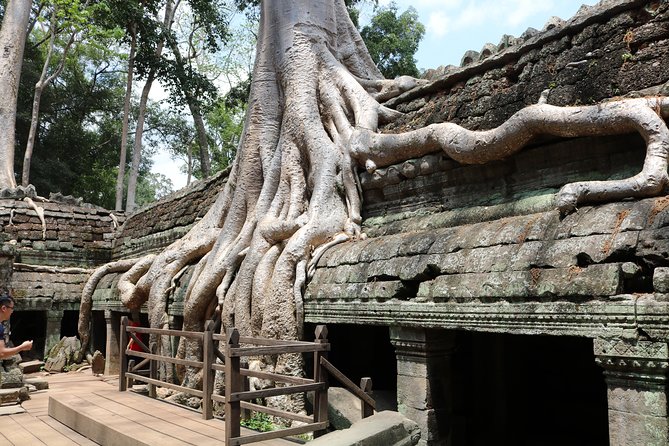
Ta Prohm is the final major stop, with about 90 minutes inside the temple. This is the ruin most associated with trees and roots pressing through old stonework, and it offers a sharp contrast to the formal scale of Angkor Wat.
The temple was once home to 2,740 monks. Today, its corridors, courtyards, and tree-covered walls create a more dramatic feeling of decay. You can expect uneven footing, narrow passages, and plenty of visual detail packed into a relatively small area.
The timing works well in one sense. After lunch, Ta Prohm gives the final part of the day a clear change of mood. You move from grand architecture to a temple that appears to be in a long conversation with the forest around it.
The limitation is that 90 minutes passes quickly. You will have time to see the best-known sections, listen to the guide, and take photographs, but not to examine every corner. If you are especially interested in temple architecture or photography, you may want to return independently on another day.
What the guide adds to the day
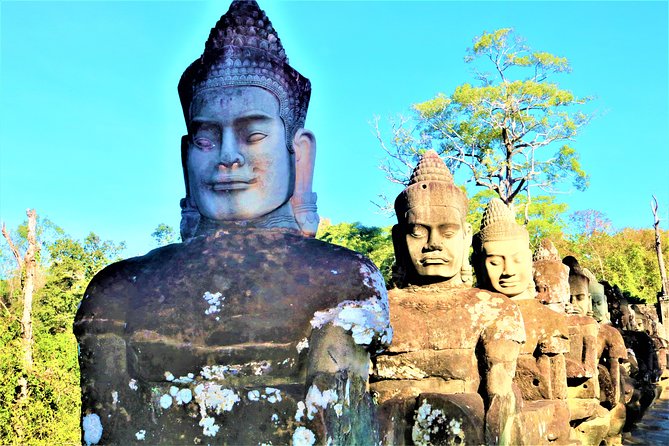
The English-speaking guide is central to the value of this tour. Without a guide, Angkor’s scale can overwhelm you, and many carvings become attractive shapes without meaning. With a good guide, the gates, faces, terraces, and temple layouts connect to Cambodia’s history and culture.
The named guides in the feedback include Noy and Sok. Noy is described as explaining both the monuments and the background of Cambodia, while Sok is praised for strong knowledge of Angkor and clear explanations during the visits. Another guide, Phalla Chhou, is listed as the operations assistant rather than a confirmed guide for every departure, so do not assume he will lead your group.
The comments also point to a useful balance between planned sightseeing and conversation. That matters in a group tour. You want enough structure to keep moving, but not a guide who delivers a nonstop speech and leaves no time for questions.
Guide quality can vary by departure, as it can with any shared tour. Still, the repeated praise for clear, pleasant, thoughtful explanations is one of the strongest reasons to choose this experience over arranging a driver alone.
Transport, group size, and pace
The air-conditioned minivan is a major practical feature. You will spend part of the day moving between temple sites, and a cool vehicle gives you a place to recover from the heat. Hotel pickup and drop-off in Siem Reap City also remove the need to arrange a separate tuk-tuk or taxi.
The tour is advertised as small group, but the supplied details give two different limits: 10 people in the main description and 15 in the additional information. That is still a modest group compared with a large coach, but the difference matters if you are choosing this specifically for a very personal experience.
The pace suits a first-time visitor who wants the major sights in one day. You see the three temples most people place at the top of their Angkor list, along with Angkor Thom’s South Gate and the terraces. The tradeoff is limited freedom. You cannot easily linger at Angkor Wat, skip a stop, or add another temple.
The tour is listed as suitable for most people, but children under 5 are not allowed on this small-group experience. The day includes walking through temple grounds and uneven ruins, so you should be comfortable spending several hours on your feet.
Is $19 a good value?
At $19 per person, the tour fee is low for an eight-hour outing with hotel transport, an English-speaking guide, air conditioning, water, and local tax. The low price becomes less striking once you add the $37 temple pass. Your base cost is therefore $56, before lunch if lunch is not included.
Even so, the value is solid if you want an organized first day. A private driver may offer more flexibility, but it does not automatically provide the same level of explanation. This tour gives you a guide, a planned route, and transport without the expense of a private vehicle.
The best value comes from the selection of temples. Angkor Wat supplies scale, Bayon supplies sculpture and mystery, and Ta Prohm supplies atmosphere. You get three distinct experiences instead of three versions of the same ruin.
Who should book this temple tour?
I would choose this tour if you have one full day in Siem Reap and want to see the essential Angkor sights with historical context. It is particularly useful if you are traveling alone, prefer not to negotiate transport, or want a social setting without joining a large coach group.
It also suits visitors who appreciate a guide’s interpretation. The strongest feedback focuses on guides who explain Cambodia as a country, not just Angkor as a collection of monuments. That wider context can make the temples easier to understand.
I would hesitate if you want sunrise photography, a very slow temple visit, or a private schedule. Sunrise is not part of the stated plan, and the 8:00 am start is designed for a full daytime circuit. I would also confirm the group size and lunch arrangement before paying, since both points need clarification.
Should you book it?
Book it if you want a well-priced, focused introduction to Angkor with hotel pickup, air-conditioned transport, and a guide who can connect the ruins to Cambodian history. The route is sensible, the temple selection is strong, and the 90-minute visit to Bayon and Ta Prohm gives each its own character.
Skip it if you already know Angkor well or need complete control over timing. For a first visit, though, the combination of Angkor Wat, Angkor Thom, Bayon, Srah Srang, and Ta Prohm makes this a practical choice. Just budget for the $37 temple pass, clarify lunch, and confirm whether your departure has a maximum of 10 or 15 people.
FAQ
What is included in the tour price?
The tour includes an English-speaking guide, hotel pickup and drop-off in Siem Reap City, an air-conditioned vehicle, mineral water, and local tax.
Is the Angkor temple pass included?
No. The temple pass must be paid directly at the site and costs $37 per person.
Is lunch included?
The information is inconsistent. One itinerary section describes lunch at a local Khmer restaurant as included, but the formal exclusions say lunch is not included and is available at your own choice. Confirm this with the operator before booking.
What time does the tour start?
The stated start time is 8:00 am.
How long does the experience last?
The tour lasts approximately eight hours.
Which temples are visited?
The route includes Angkor Wat, Angkor Thom’s South Gate, Bayon Temple, Srah Srang for the lunch break, and Ta Prohm. It also passes the Terrace of the Leper King and the Terrace of the Elephants.
How many people are in the group?
The tour is described as a small group with a maximum of 10 people, but the additional information states a maximum of 15 travelers. Confirm the expected group size before booking.
Are young children allowed?
Children under 5 years old are not allowed on this small-group tour.
Can I cancel for a full refund?
Yes, you can cancel up to 24 hours before the experience start time for a full refund. Changes or cancellations made less than 24 hours before the start time are not accepted for a refund.
Just added around Siem Reap
- Ultimate Sunrise to Angkor Wat, Angkor Thom and Bayon Temple★ 5.0 · 3 reviews
- Full-Day Private Tour of Angkor Wat with Pick Up★ 5.0 · 12 reviews
- Trekking Tour at Phnom Kulen National Park from Siem Reap★ 5.0 · 3 reviews
- Twilight Tastes of Siem Reap Include Dinner★ 5.0 · 13 reviews
- Siem Reap City Tour with War Museum and Killing Field★ 5.0 · 27 reviews
- Private Day Trip to Angkor Temples with Expert Guide★ 5.0 · 4 reviews
- Waterfall & River of 1000 Siva Linga- Kulen Mountain Private Tour★ 5.0 · 3 reviews
- Private Two Days Siem Reap Temples Discovery Guided Tour★ 5.0 · 7 reviews
Angkor Wat Tours, compared.
Angkor Wat Sunrise or Sunset Tour with Guide from Siem Reap
Read our review →
Angkor Wat: Small-Group Sunrise or Sunset Tour
Read our review →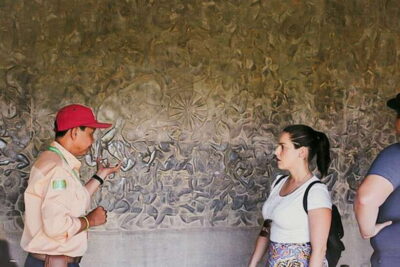
Angkor Wat 2-Day Tour with Sunrise and Sunset
Read our review →
Angkor Wat Sunrise tour with Small – Group and Guide tours
Read our review →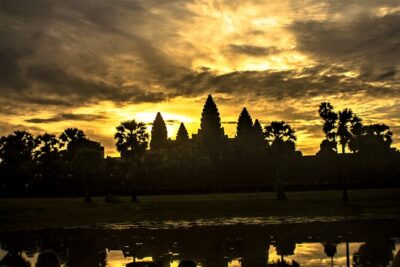
Angkor Wat Highlights and Sunrise Guided Tour from Siem Reap
Read our review →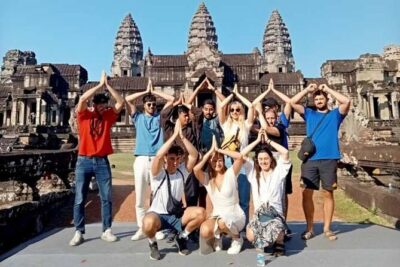
Angkor Wat Sunset Small Group Tour with Lunch Included
Read our review →