Reviewed · ANGKOR WAT TOURS
Full-Day private Tour in Lost City & Angkor Wat from Siem Reap
Angkor Wat is the star, but this tour gives you the full ancient-city sweep in one day. You enter from the less-used eastern side, follow a jungle path, study the temple’s enormous carvings, and reach the upper levels before moving on to Angkor Thom and Ta Prohm.
I like the private format, which lets you set the pace, and I like the guide-led storytelling at places such as Bayon, where 200-plus stone faces can blur into one another without context. The main drawback is the packed schedule: eight hours in Cambodia’s heat, with many temple stops, can leave you tired before Ta Prohm.
Key points
- Eastern-side entry at Angkor Wat: Begin away from the usual approach and walk toward the temple through a quieter route.
- Private vehicle and guide: Hotel pickup, drop-off, bottled water, and an English-speaking guide are included.
- A full Angkor Thom circuit: See the South Gate, Bayon, Baphuon, Phimeanakas, and two royal terraces.
- Ta Prohm at the end: Finish among tree roots and partially restored ruins at the Tomb Raider temple.
- Low listed price: The $30 per-person cost covers transport and guiding, but not the Angkor temple pass.
- Flexible pacing: Guide Sim was praised for adjusting the order and adding a break when the day became tiring.
The eastern approach to Angkor Wat
The day begins with hotel pickup in Siem Reap and a private ride to the Angkor complex. Your guide sends a link in advance so you can purchase the required temple entrance e-ticket. That admission cost is separate from the $30 tour price, so include it when working out your total budget.
Most visitors first picture Angkor Wat’s famous western causeway. This tour uses the less-visited eastern side instead, then takes you along a jungle path toward a temple pool and the main sanctuary. That route gives the morning a quieter start and changes the way you see the monument. You are not simply walking straight toward the postcard view. You are approaching it through trees, water, stone, and shadow.
Allow about two hours for Angkor Wat. Your guide explains the temple’s construction in the early 12th century, its role as a major religious center, and the stories carved into its walls. The bas-reliefs are not just decoration. They present scenes from mythology, warfare, court life, and daily activity, but the scale can be hard to grasp without someone pointing out what you are seeing.
The central chambers and upper terraces require walking and stairs. You should wear flat shoes with good grip and expect an active morning. Clothing must cover your knees and shoulders when entering sacred areas, so lightweight trousers or a longer skirt and a shirt with sleeves are practical choices.
Angkor Wat is the most important stop, but it can also be the most demanding. The stone surfaces and open courtyards reflect the heat, and an eight-hour temple circuit gives you little room for a long rest unless you ask for one. The private arrangement helps here. You can tell your guide when you need water, shade, or a slower pace.
More Angkor Wat tours in Siem Reap:
- Angkor Wat Sunrise or Sunset Tour with Guide from Siem Reap
★ 5.0 · 12,109 reviews - Siem Reap: Angkor Wat: Small-Group Sunrise or Sunset Tour
★ 5.0 · 9,444 reviews - Siem Reap: Angkor Wat 2-Day Tour with Sunrise and Sunset
★ 4.9 · 4,429 reviews
Angkor Thom begins at the South Gate
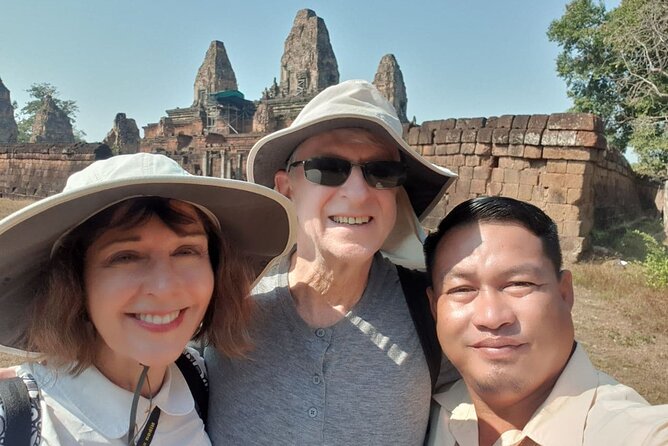
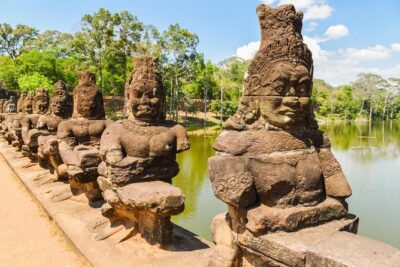
After Angkor Wat, the vehicle takes you to the South Gate of Angkor Thom, the old Khmer capital. The gate is framed by rows of 54 stone figures on each side, creating a ceremonial entrance over the moat. The figures represent a struggle between opposing forces, a theme tied to Hindu mythology.
You get about 20 minutes here. That is enough for photographs and a quick explanation, but not for lingering over every detail. The gate is one of the busiest photo stops in the Angkor area, so your guide can help you understand the scene before you move into the former capital.
Angkor Thom was a huge fortified city, more than a single temple. Its broad enclosure once held royal buildings, religious sites, public spaces, and residences. The scale matters. After spending the morning inside Angkor Wat, you begin to see how the Khmer rulers planned an entire capital around power, religion, and ceremony.
Bayon and its 200-plus stone faces
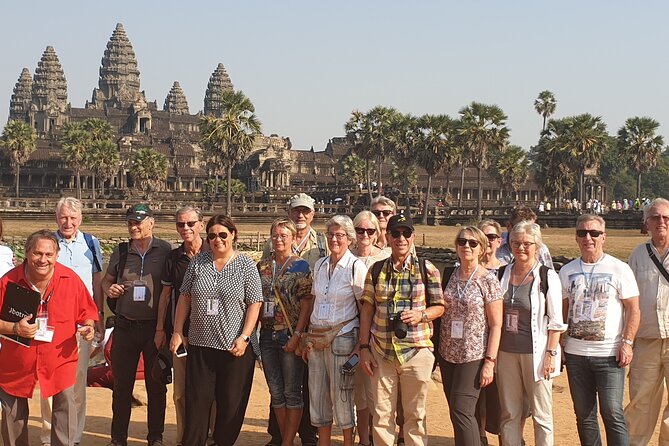
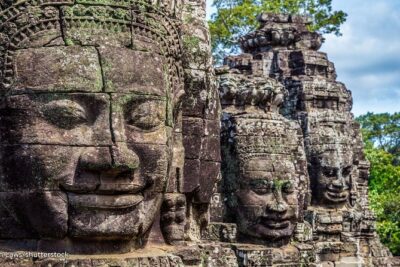
Bayon is the emotional center of the Angkor Thom section. Built in the 13th century as the state temple of King Jayavarman VII, it is known for towers topped with enormous serene faces. More than 200 faces look out from the upper levels, though the exact effect changes as you move around the temple.
Give this stop about an hour. Bayon is compact, crowded with towers, and full of visual distractions. A guide is especially useful here because the faces are only part of the story. The outer galleries show historical events and ordinary Khmer life, while the inner galleries focus more on mythological scenes.
Look closely at the lower carvings. You may see markets, processions, battles, boats, animals, and household scenes mixed with religious imagery. These details make Bayon feel less like an isolated monument and more like a record of a working society.
The stone faces create memorable photographs, but the temple can feel confusing if you move through it too quickly. Stay near your guide for the first part, then take a few minutes to look on your own. The private format means you can spend more time on the carvings that catch your eye instead of following a large group.
Baphuon reveals Angkor Thom’s older layers
Baphuon sits northwest of Bayon and was built in the mid-11th century as a temple mountain. Its three rising levels once carried a tall central tower, making the monument roughly 50 metres high when complete. Even without that original tower, the long approach and steep form make Baphuon feel imposing.
The tour allows about an hour here. You will walk across a long raised causeway toward the temple and climb through its stepped structure. This is another place where comfortable shoes matter. The surfaces can be uneven, and the ascent is more strenuous than a simple courtyard walk.
Baphuon also helps you compare different periods of Khmer construction. Bayon belongs to the era of Jayavarman VII, while Baphuon is older. Seeing both on the same morning gives you a useful sense of change in royal style and religious purpose, rather than treating Angkor as one single period.
More full-day trips in Siem Reap:
- Siem Reap: Full-Day Angkor Wat Guided Tour with Sunset
★ 4.9 · 3,803 reviews - Full-Day Angkor Wat Sunrise Private Tour with Guide from Siem Reap
★ 5.0 · 2,920 reviews - Siem Reap: Angkor Wat Sunrise and Full-Day Sightseeing Tour
★ 4.9 · 2,828 reviews - Full-Day Guided Sunset Tour of Angkor Wat
★ 5.0 · 1,507 reviews
Royal spaces, terraces, and a quieter stop
The route continues through Angkor Thom, including a less familiar stop described as a place many visitors miss. The exact details of this short 10-minute visit are not specified, so think of it as a brief pause rather than a major monument. Its value is that your guide can use the private route to show you something outside the standard headline stops.
Phimeanakas comes next. This pyramid temple was built near the end of the 10th century and later completed under Suryavarman I. It sits inside the walled Royal Palace enclosure and was designed as a three-level Hindu temple, with a tower once rising from the top.
You have about an hour for Phimeanakas. Compared with Angkor Wat and Bayon, it usually feels less visually overwhelming. That can be welcome by this point in the day. The temple gives you a chance to focus on the layout of the royal compound and imagine how religious buildings fitted into the larger court complex.
The Terrace of the Elephants follows, with about 40 minutes to see its long carved platform. Built in the 13th century under Jayavarman VII, the 350-metre terrace functioned as a reviewing stand for ceremonies and royal audiences. Elephant carvings line the structure, but the terrace’s length is just as striking as its decoration.
You will likely walk along the platform rather than explore a dark interior. It is a good place to understand public power in Angkor. The king did not merely worship inside temples. He appeared before people from a raised ceremonial platform designed to display authority.
The Terrace of the Leper King is another 40-minute stop. Its U-shaped structure may have served as a royal cremation site, though its exact purpose remains debated. The modern name comes from a sculpture found here that depicts Yama, the Hindu god of death.
The terrace has carved surfaces and narrow passages that reward a slower look. Your guide can separate what is known from what remains uncertain, which is important at Angkor. Not every interpretation is settled, and the site is more interesting when you understand that.
A flexible break before Ta Prohm
Lunch is taken at a restaurant near the temples, with cold drinks available. The meal is not listed as included, so budget separately for food. This stop matters more than it may sound. The day involves long walks, open stone courtyards, and heavy heat, so a seated break can help you finish well.
One useful detail from the guiding style is flexibility. Guide Sim adjusted the order of the temples for one group and added time at a coffee place near Angkor Wat when fatigue set in. You should not assume every guide will make the same change, but on a private tour it is reasonable to discuss your energy level and priorities early in the day.
The schedule includes another short 10-minute stop described as a secret or special place. No exact site name is provided, so you should treat this as an added pause rather than a guaranteed major attraction. Ask your guide what you are seeing and how long you will have there.
Ta Prohm finishes the day under tree roots
Ta Prohm is the final major temple, and its mood differs sharply from Angkor Wat and Bayon. Built in the 12th or 13th century under Jayavarman VII, it was once a religious center connected with the ancient Khmer university. UNESCO added it to the World Heritage List in 1992.
The temple is famous for its trees growing through the ruins. Roots grip walls, corridors, and fallen stones, creating the atmospheric setting often associated with the Tomb Raider film. The attraction is not only the trees. Ta Prohm also shows what a large temple complex looks like when nature and stone share the same space.
Plan on about an hour here. Ta Prohm can feel especially tiring at the end of a full day because its paths are uneven and its narrow sections often require patience. It is also one of the most popular stops in the Angkor area, so the private vehicle does not guarantee solitude.
Still, finishing here makes sense. The temple offers a strong final image after the more formal geometry of Angkor Wat and the face towers of Bayon. You move from royal order to partial collapse, from broad ceremonial spaces to tight corridors and roots.
What the $30 price really covers
At $30 per person, the tour offers good value if you want a guide, private transport, and a full day of major Angkor sites without arranging each ride yourself. Hotel pickup and drop-off remove the need to negotiate transport in Siem Reap, while bottled water is included.
The price does not include the Angkor entrance fee or lunch. That distinction is important. The tour is inexpensive because the major admission charge sits outside the listed price, so do not compare $30 directly with an all-inclusive package.
The biggest value comes from the private format. You are not locked into a large group’s pace, and you can ask for more detail at Angkor Wat or Bayon, or less time when temple fatigue sets in. The guide’s role is central. Rith was praised for clear explanations and for keeping his own sense of wonder, while Sim was noted for extensive explanations and flexibility.
The overall rating is 5 from 17 ratings, with 100 percent recommending the experience. That suggests strong satisfaction, especially with the guides, but the small number of ratings should not hide the basic tradeoff: this is a demanding full-day temple circuit in hot conditions.
Who should book this private temple day
I would choose this tour if you have one full day in Siem Reap and want to cover Angkor Wat, Angkor Thom, Bayon, Baphuon, and Ta Prohm with a local English-speaking guide. It suits first-time visitors who want the major sites explained rather than simply photographed.
It also suits couples, families, friends, or any small party that values control over the pace. The private vehicle is helpful when you need a short rest, want to reorder a stop, or prefer to spend extra time at one temple.
I would think twice if you dislike long walking days or want a slow visit with only two or three temples. The itinerary includes many stops, and even the shorter pauses add to the overall fatigue. You should also be comfortable with the fact that admission and lunch cost extra.
Free cancellation is available until 24 hours before the start time. Changes or cancellations within 24 hours are not accepted for a refund.
Should you book it?
Book this tour if you want a high-value introduction to Angkor with private transport and a guide who can explain the carvings, royal spaces, and religious meaning. The eastern entry at Angkor Wat, the full Angkor Thom circuit, and the final hour at Ta Prohm give you a broad and memorable day.
Choose a slower private itinerary instead if you already know the main temples or if heat and stairs are a serious concern. For most first-time visitors with one day available, the combination of coverage, flexibility, and low listed price makes this a practical choice, provided you budget separately for the temple pass and lunch.
FAQ
How long does the tour last?
The tour lasts about eight hours.
Is hotel pickup included?
Yes. Hotel pickup and drop-off in Siem Reap are included.
Is this a private tour?
Yes. Only your group participates in the activity.
Is the Angkor entrance fee included?
No. The Angkor temple admission fee is separate from the tour price.
Is lunch included?
No. Lunch is taken at a restaurant near the temples, but the meal is not listed among the inclusions.
What does the $30 price include?
The price includes an English-speaking guide, a private comfortable vehicle, hotel pickup and drop-off, and bottled water.
Which temples are visited?
The route includes Angkor Wat, the South Gate of Angkor Thom, Bayon, Baphuon, Phimeanakas, the Terrace of the Elephants, the Terrace of the Leper King, and Ta Prohm. It also includes two short stops described as special or secret locations.
What should I wear?
You need clothing that covers your knees and shoulders to enter some sacred temple areas. Flat, comfortable walking shoes are recommended.
Can I cancel for a full refund?
Yes. You can cancel at least 24 hours before the experience start time for a full refund. Cancellations or changes made within 24 hours are not accepted for a refund.
Just added around Siem Reap
- Ultimate Sunrise to Angkor Wat, Angkor Thom and Bayon Temple★ 5.0 · 3 reviews
- Full-Day Private Tour of Angkor Wat with Pick Up★ 5.0 · 12 reviews
- Trekking Tour at Phnom Kulen National Park from Siem Reap★ 5.0 · 3 reviews
- Twilight Tastes of Siem Reap Include Dinner★ 5.0 · 13 reviews
- Siem Reap City Tour with War Museum and Killing Field★ 5.0 · 27 reviews
- Private Day Trip to Angkor Temples with Expert Guide★ 5.0 · 4 reviews
- Waterfall & River of 1000 Siva Linga- Kulen Mountain Private Tour★ 5.0 · 3 reviews
- Private Two Days Siem Reap Temples Discovery Guided Tour★ 5.0 · 7 reviews
Angkor Wat Tours, compared.
Angkor Wat Sunrise or Sunset Tour with Guide from Siem Reap
Read our review →
Angkor Wat: Small-Group Sunrise or Sunset Tour
Read our review →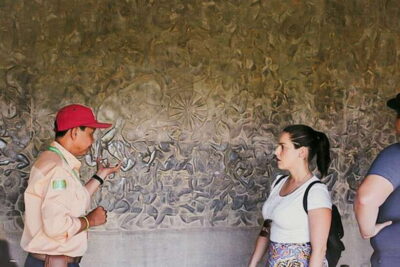
Angkor Wat 2-Day Tour with Sunrise and Sunset
Read our review →
Angkor Wat Sunrise tour with Small – Group and Guide tours
Read our review →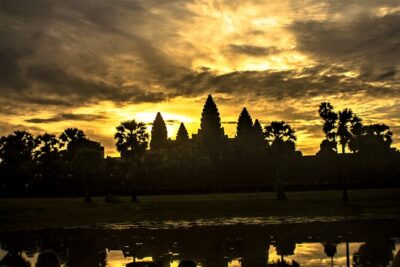
Angkor Wat Highlights and Sunrise Guided Tour from Siem Reap
Read our review →
Angkor Wat Sunset Small Group Tour with Lunch Included
Read our review →