Reviewed · ANGKOR WAT TOURS
Exclusive Angkor temples and Small group temples tours
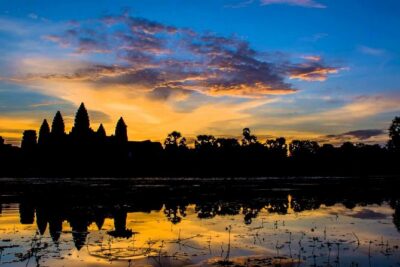
Angkor’s greatest hits come in one long, well-planned day: the smiling stone faces of Bayon, jungle-wrapped Ta Prohm, and the vast galleries of Angkor Wat. You also finish with sunset at Phnom Bakheng, a Hindu and Buddhist mountain temple above the old capital.
I like the hotel pickup and air-conditioned van or bus, especially in Siem Reap’s heat. I also like that the guide and driver help with photographs, including choosing good places to stand, according to the experience details. The main catch is cost: the $19 tour price does not include the $37 temple pass or lunch and dinner.
Key points
- A full Angkor circuit in one day: See Angkor Thom, Bayon, Ta Prohm, Angkor Wat, and Phnom Bakheng.
- Hotel-to-hotel convenience: Pickup and drop-off are included, with air-conditioning and mineral water during the tour.
- A local English-speaking guide: Expect explanations about Khmer history, religion, architecture, and the purpose of each major site.
- Small group, but not private: The maximum group size is 25 people, so the van or bus should feel more personal than a large coach.
- Sunset closes the day: Phnom Bakheng adds a mountain temple and evening view after the main ruins.
- Budget price with extra costs: The $19 fee covers the tour service, but you must budget another $37 for temple admission and money for meals.
What this Angkor day is really designed to do
This is a first-time Angkor tour built around the famous sites. You spend the day moving through the old Khmer capital, beginning at Angkor Thom and ending with sunset near Phnom Bakheng.
The route combines royal roads, carved temple towers, enormous stone faces, jungle growth, and the grand scale of Angkor Wat. That variety matters. If you visited only Angkor Wat, you would miss how different the temples can feel from one another.
You are not paying $19 for entrance to the monuments. You are paying for the vehicle, hotel transfers, guide, bottled water, and the organization needed to connect several large sites in one day. Add the $37 temple entrance fee and your basic day cost becomes $56 before food.
That remains a useful price for a long day with transport and guiding, but you should know the full cost before booking. Meals are not included, so bring money for lunch and dinner. The description gives an approximate duration of six to ten hours, which is a wide range, but the number of stops and sunset finish explain why the day can run long.
More Angkor Wat tours in Siem Reap:
- Angkor Wat Sunrise or Sunset Tour with Guide from Siem Reap
★ 5.0 · 12,109 reviews - Siem Reap: Angkor Wat: Small-Group Sunrise or Sunset Tour
★ 5.0 · 9,444 reviews - Siem Reap: Angkor Wat 2-Day Tour with Sunrise and Sunset
★ 4.9 · 4,429 reviews
Leaving Siem Reap in an air-conditioned vehicle
The tour includes pickup and drop-off at the hotel where you are staying. That removes one of the more tiresome parts of an Angkor day: arranging transport before sunrise or after a hot afternoon among the ruins.
The vehicle is an air-conditioned van or bus. The maximum group size is 25 people, so this is a small-group service rather than a private tour. If you want complete control over every stop, a private vehicle would suit you better. If you want lower cost and a guide without managing the route yourself, this format makes sense.
Mineral water is provided during the tour. That is a modest inclusion, but a useful one in Cambodia’s heat. You will spend much of the day walking over stone, climbing steps at some sites, and crossing open courtyards with little shade.
The day depends on the guide’s timing. Each major stop has a planned block of time, but temple visits can feel quick if you want to study every carving. I would treat this as an introduction to Angkor rather than a slow archaeological visit.
Angkor Thom and the South Gate
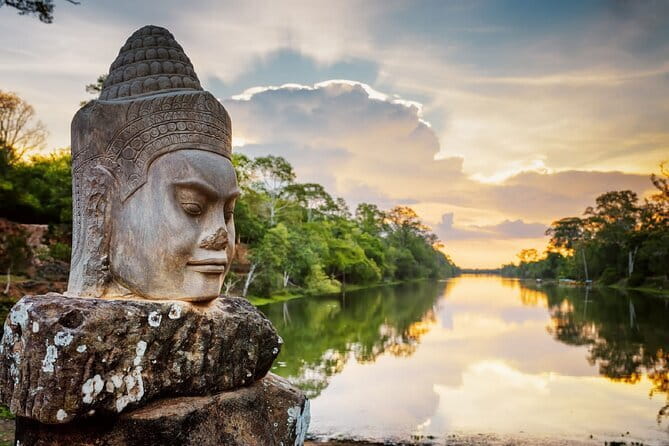
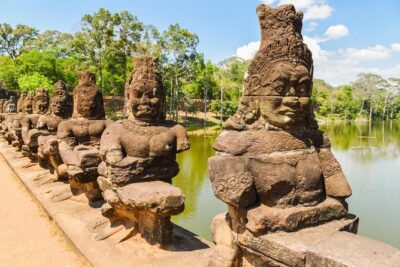
Angkor Thom means great city, and the name fits. This was the Khmer capital, a large walled urban center rather than a single temple. The South Gate gives you an immediate sense of the ceremonial scale of the place.
The approach is part of the experience. The gate is linked to the famous line of figures associated with the Churning of the Ocean of Milk, a Hindu story about gods and demons seeking the elixir of life. Your guide can give this scene meaning instead of leaving you to see it as a row of worn stone statues.
The South Gate visit is scheduled for about 30 minutes, followed by about an hour within Angkor Thom. That gives you time to get oriented, see the walls and entrances, and begin understanding how the city was arranged.
The practical drawback is that the word Angkor Thom covers a large area. You are not exploring every corner of the ancient capital in one hour. This is a selected visit to the main sights, designed to keep the wider day moving.
Bayon’s smiling stone faces
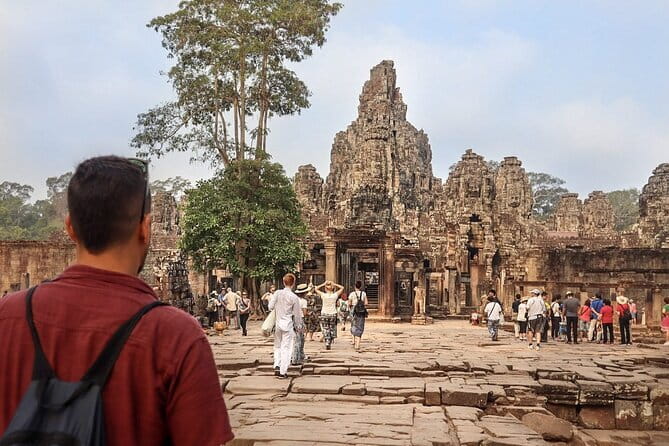
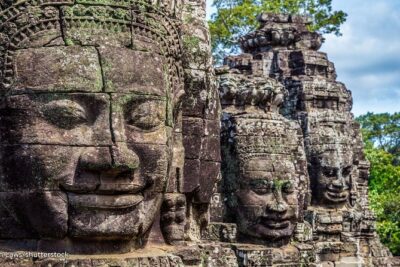
Bayon is the emotional center of the Angkor Thom visit. Its towers carry enormous carved faces, calm and slightly mysterious, looking out over the temple from different heights.
The temple was built in the late 12th or early 13th century as a state temple. Its design is less orderly than Angkor Wat, with galleries, towers, passageways, and reliefs packed into a compact space. You may find yourself looking up one moment and studying a detailed carving at eye level the next.
I like this stop because a good guide can explain why Bayon feels so different from Angkor Wat. The temple is not simply a smaller version of the famous monument. Its face towers, stone reliefs, and layered plan reflect another stage of Khmer building and religious life.
Allow about an hour here. Wear shoes with a firm grip and expect uneven stone. The temple rewards patience, but the group schedule means you should stay aware of the meeting point and departure time.
A different sort of day out around Siem Reap:
- From Siem Reap: Kampong Phluk Floating Village Tour by Boat
★ 4.9 · 6,979 reviews - Sunset tour of Kampong Phluk stilts home village on the Tonle Sap
★ 5.0 · 4,865 reviews - Siem Reap: Full-Day Angkor Wat Guided Tour with Sunset
★ 4.9 · 3,803 reviews - Angkor Wat Sunrise tour with Small – Group and Guide tours
★ 5.0 · 3,655 reviews
The Terraces of the Elephants and the Leper King
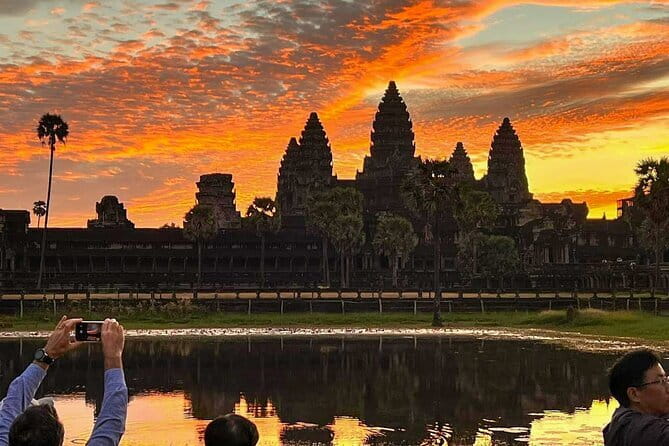
The Terrace of the Elephants is a long ceremonial platform in Angkor Thom, decorated with elephant imagery. It gives you a sense of the royal center as a place for processions, public display, and court life.
The visit is scheduled for about 30 minutes. That is enough for an overview and photographs, but not a long architectural study. This stop works well between the enclosed temple visits because it lets you look across a more open section of the ancient capital.
The Terrace of the Leper King adds another layer of Khmer sculpture and storytelling. Its name comes from a statue whose discoloration and moss were compared with the appearance of leprosy. The name is memorable, but the site deserves attention for its carved walls and religious imagery rather than only the statue’s nickname.
Taken together, these terraces help you understand that Angkor Thom was more than a collection of isolated temples. It was a capital with ceremonial routes, public spaces, walls, gates, and monuments built for royal power.
Ta Prohm, where stone meets jungle
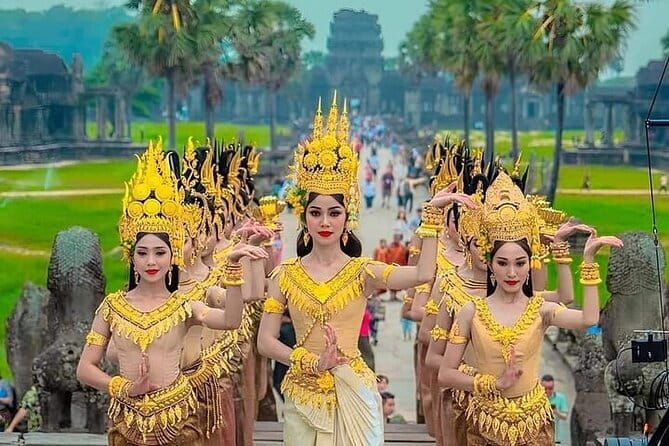
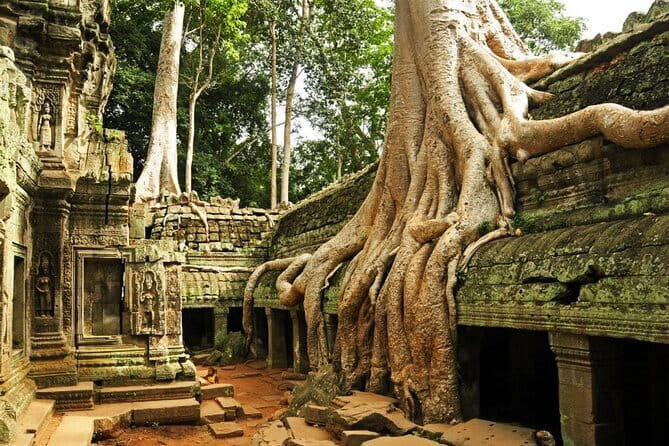
Ta Prohm was founded by King Jayavarman VII as a Mahayana Buddhist monastery and university. It is one of the most atmospheric stops because the temple remains closely tied to the surrounding trees and jungle growth.
You will see collapsed galleries, narrow passages, carved stone, and roots that press against or over parts of the structure. Ta Prohm feels less controlled than Angkor Wat. That is its charm, but it also means you should watch your footing and allow time for the guide to point out what is original structure, later damage, or plant growth.
The visit lasts about an hour. That is a useful amount of time for the principal paths and the best-known views. You may want longer if you enjoy photography, but the day still has Angkor Wat and sunset ahead.
Ta Prohm is also a good place to listen to the guide. Without context, it can look like a dramatic ruin made for pictures. With context about its religious and educational role, you see why the site mattered before the trees became its most famous feature.
Three hours at Angkor Wat
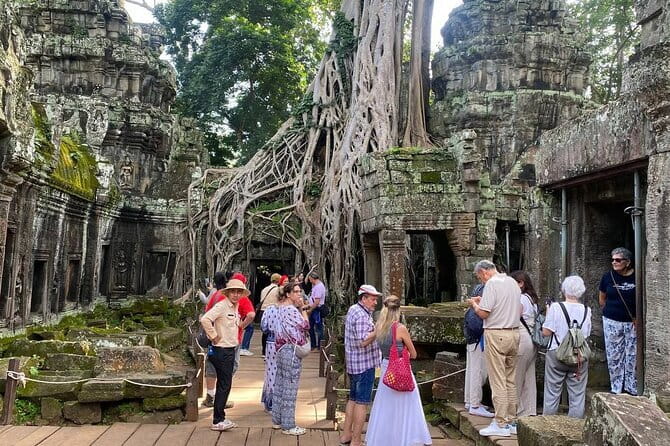
Angkor Wat receives the longest scheduled visit, about three hours, and it needs it. This is the largest religious monument in the world, spread across a huge site with towers, galleries, courtyards, and carved scenes.
The scale can be hard to grasp from a single viewpoint. You move from the broad outer setting toward the central temple, then through long galleries and enclosed spaces. The carvings and architecture reward a slower pace than the shorter stops allow.
I recommend listening to the introduction from the guide, then using part of the three hours to walk at your own speed. Ask about the temple’s original Hindu purpose, later Buddhist use, and the meaning of the reliefs. A guide can also help you understand how the structure was planned, rather than leaving you with only the familiar front view.
Three hours is generous compared with the other stops, but it is not excessive. Angkor Wat is physically large, and the heat can slow you down. Carry the provided water, keep your pace sensible, and do not feel obliged to see every gallery if you are tired.
The main limitation is that this is still a shared schedule. If Angkor Wat is your chief reason for coming to Cambodia, you may eventually want a separate visit with more time. For a one-day introduction, however, the three-hour block gives you a fair look at the monument.
Sunset at Phnom Bakheng
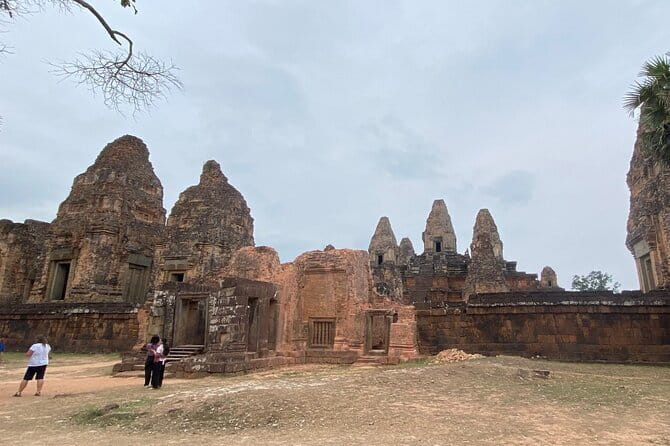
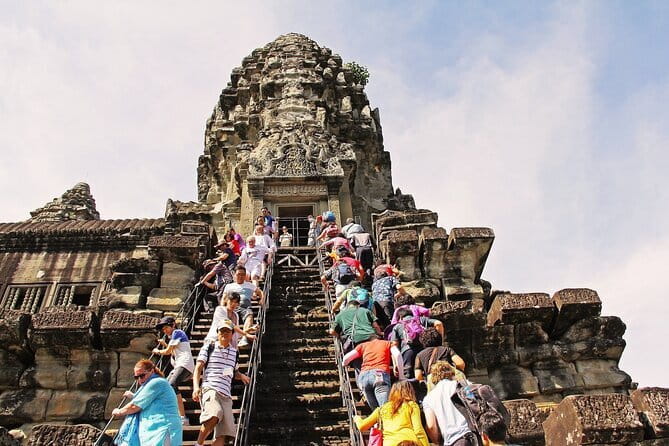
The day ends at Phnom Bakheng, a Hindu and Buddhist mountain temple. The climb and elevated setting change the mood after hours among enclosed galleries and stone corridors.
Here, the reward is the evening view and the sense of looking back across the area around Angkor. Sunset is a natural final chapter, though the timing makes the day less predictable than a simple morning tour. The full experience can last anywhere from six to ten hours, and the sunset finish is the main reason to allow a wide window.
Do not book this tour if you need to return to Siem Reap at a precise early hour. The tour promises a transfer back to your hotel after sunset, but sunset itself fixes the end of the day.
The temple is both Hindu and Buddhist, which gives your guide another chance to explain how religious traditions changed and continued across the Angkor period. Phnom Bakheng is not just a viewpoint added at random. It is a religious monument with its own place in the wider story of Angkor.
The guide and driver matter here
A long Angkor day can become a tiring sequence of stops if the guide gives only basic directions. This tour includes an English-speaking local guide, so you can expect help connecting the temples to Khmer history, religion, and royal power.
The strongest praise attached to this experience focuses on the guide and driver working as a team. They were described as fun, helpful, and good at choosing places for photographs. The guide and driver also took pictures for the customer, which is useful when you want a group photo or a shot with the temple behind you.
That does not promise a particular guide by name, and no guide names are provided. Still, the photographic help is a practical detail worth noting. You can ask politely when you reach a good viewpoint, rather than trying to manage a phone or camera while moving through the ruins.
The driver’s role matters too. Angkor sites are spread out, so comfortable transfers between stops save energy for the monuments themselves. Air-conditioning becomes especially valuable during the middle of the day.
What the $19 price does and does not cover
At $19, this is an inexpensive way to organize a full Angkor circuit. The price includes the English-speaking guide, air-conditioned vehicle, hotel pickup and drop-off, and mineral water.
You must add the temple entrance fee of $37 per person. Meals are also extra. That makes the realistic minimum price $56 before food, not $19.
Even at that total, the tour can offer solid value if you want to see the principal Angkor sites in one day. You are getting transportation across a large area, a guide, and a sunset stop without having to arrange each part separately.
The value is weaker for someone who already has transport, knows the temples well, or wants a very slow visit at one monument. In that case, paying for a group itinerary may restrict you. For a first visit, the convenience is the main reason to consider it.
Who should book this tour
I would choose this tour if you are visiting Angkor for the first time and want the major sights in one day. It suits you if hotel transport, a guide, air-conditioning, and a low upfront price matter more than a private schedule.
It is also a good match for solo visitors or couples who want company without joining a very large coach. The maximum group size is 25, so it is not intimate, but it should be more manageable than a mass tour.
Families and older visitors should consider the full duration, heat, uneven temple surfaces, and the sunset finish. The information says most people can participate, but the day still involves considerable walking around ancient ruins.
You may want a different arrangement if Angkor Wat is your only priority, if you want extensive photography time, or if you need to leave the temples before sunset. The route is broad, not slow.
Free cancellation is available if you cancel at least 24 hours before the start time. Changes or cancellations made less than 24 hours ahead are not accepted for a refund.
Should you book the Angkor small-group tour?
Book it if you want the main Angkor temples, hotel transfers, an English-speaking guide, and sunset at Phnom Bakheng without paying for a private vehicle. The $19 headline price is attractive, but plan on $37 for admission plus meals.
Skip it if you prefer to spend a full day at only one or two temples, need a fixed return time, or dislike shared schedules. For most first-time visitors with limited time in Siem Reap, the route gives you a sensible first look at Angkor’s great variety, from Bayon’s faces to Ta Prohm’s roots and Angkor Wat’s grand galleries.
FAQ
Is the temple entrance fee included?
No. The temple entrance fee is listed as $37 per person and is not included in the tour price.
Are meals included?
No. Lunch and dinner are not included, so you should budget separately for food.
Does the tour include hotel pickup and drop-off?
Yes. Pickup and drop-off from the hotel where you are staying are included.
How long does the tour last?
The approximate duration is six to ten hours. The day concludes after sunset at Phnom Bakheng, followed by transfer back to your hotel.
What is the maximum group size?
The maximum group size is 25 people.
What is included in the vehicle service?
An air-conditioned van or bus is included, along with an English-speaking guide and mineral water during the tour.
Just added around Siem Reap
- Ultimate Sunrise to Angkor Wat, Angkor Thom and Bayon Temple★ 5.0 · 3 reviews
- Full-Day Private Tour of Angkor Wat with Pick Up★ 5.0 · 12 reviews
- Trekking Tour at Phnom Kulen National Park from Siem Reap★ 5.0 · 3 reviews
- Twilight Tastes of Siem Reap Include Dinner★ 5.0 · 13 reviews
- Siem Reap City Tour with War Museum and Killing Field★ 5.0 · 27 reviews
- Private Day Trip to Angkor Temples with Expert Guide★ 5.0 · 4 reviews
- Waterfall & River of 1000 Siva Linga- Kulen Mountain Private Tour★ 5.0 · 3 reviews
- Private Two Days Siem Reap Temples Discovery Guided Tour★ 5.0 · 7 reviews
Angkor Wat Tours, compared.
Angkor Wat Sunrise or Sunset Tour with Guide from Siem Reap
Read our review →
Angkor Wat: Small-Group Sunrise or Sunset Tour
Read our review →
Angkor Wat 2-Day Tour with Sunrise and Sunset
Read our review →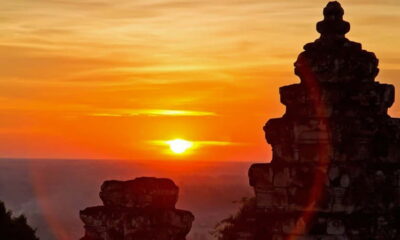
Angkor Wat Sunrise tour with Small – Group and Guide tours
Read our review →
Angkor Wat Highlights and Sunrise Guided Tour from Siem Reap
Read our review →
Angkor Wat Sunset Small Group Tour with Lunch Included
Read our review →