
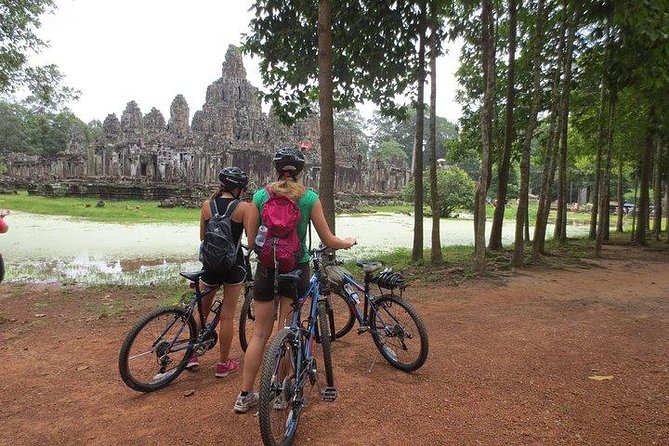
Reviewed · ANGKOR CYCLING TOURS
Angkor Region & Rainforest Bike Tour
Angkor Wat is only part of the story here. This eight-hour bike tour links the famous temples with forest tracks, old walls, and quieter routes that let you see the ancient complex at a slower, more personal pace. You’ll ride with an English-speaking guide and a group capped at 10 people.
I like two things right away: quality Trek mountain bikes and helmets are included, so you do not need to hunt down rental gear, and the ride mixes major sights with rougher rainforest paths. Lunch, coconut water, and drinking water also make the long day easier. The main drawback is the physical demand. Mud, heat, uneven trails, and a full day in the saddle may not suit everyone.
Key points to know before booking
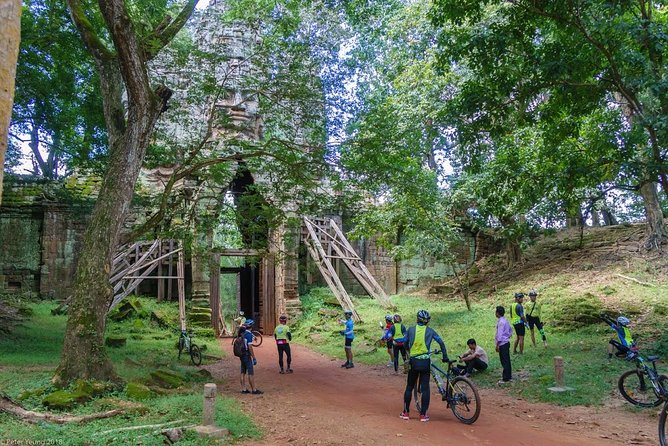
- Five major temple visits: Angkor Wat, Bayon, Preah Khan, Tanei, and Ta Prohm are included in the route.
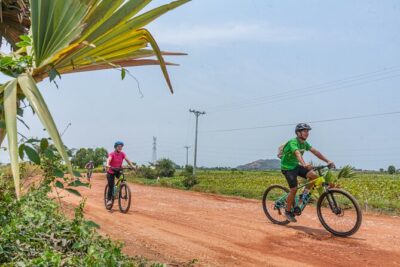
- Rainforest riding: Expect natural forest paths, including wet or muddy sections in rainy weather.
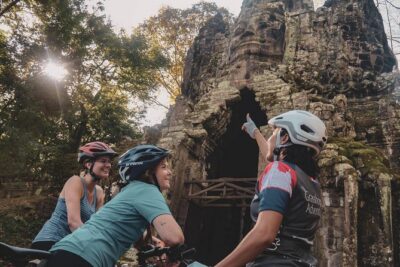
- Angkor Thom by bicycle: You ride near the South Gate, West Gate, and North Gate, then climb onto the old defensive wall toward Prasat Chrung.
- Small-group format: The maximum group size is 10 people, with an English-speaking guide leading the way.
- Useful inclusions: A Trek mountain bike, helmet, lunch, coconut water, and pure drinking water are provided.
- Budget reminder: The tour costs $50 per person, but the one-day temple pass costs an extra $37.
Why a bicycle changes your Angkor day
Angkor is often experienced from the back seat of a car or tuk-tuk. That works well for covering ground, but a bicycle gives you a different rhythm. You hear the forest, notice the shade between monuments, and move through the site under your own power.
This is not a gentle city ride. The route uses rainforest trails and natural paths away from the main tourist roads. In wet conditions, those trails can become muddy. One returning rider described a wet, muddy day as part of the fun, which tells you something useful: the route is designed for a bit of adventure, not polished pavement from start to finish.
The reward is a stronger sense of place. Angkor was the political and religious center of the Khmer Empire from the ninth to the fifteenth centuries. Cycling through its forest setting helps you understand how large and spread out the complex is. You are not simply stepping out at one temple, taking photographs, and getting back in a vehicle.
The group size matters, too. With no more than 10 people, the guide can keep an eye on the pace and help the group negotiate the trail. The experience is still a guided tour, but it should feel less like being moved through a procession.
More bike tours in Siem Reap:
- Siem Reap Countryside Bike Tour / E-Bike or Tuk Tuk
★ 5.0 · 935 reviews - Angkor Sunrise Bike Tour / E-Bike or Tuk Tuk
★ 5.0 · 615 reviews - Siem Reap: Bike the Angkor Temples – Full-Day 30km Tour
★ 5.0 · 463 reviews
Starting at 7:30 am from Siem Reap
The tour begins at 7:30 am at Angkor Cycling Tour on Taphul Road in Siem Reap. Hotel pickup and drop-off are not included, so you need to arrange your own way to the meeting point.
An early start makes sense. You have a long route ahead, and morning riding is generally easier than spending the whole day in the heat. The start also gives you time to reach several temples without turning every stop into a rushed photograph.
Bring sunscreen, sunglasses, and a camera. You should also wear clothing suitable for cycling while keeping the temple dress rules in mind. Angkor remains an active spiritual place. Shorts and skirts above the knees, along with bare shoulders, are not allowed in sacred areas. Respectful clothing is not just a formality here, it helps you enter the sites appropriately.
The operator asks for each passenger’s height when booking. That is a small but important detail because the bike needs to fit you properly. If you have dietary requirements, provide them in advance so lunch can be planned.
Angkor Wat begins the temple route
Angkor Wat is the headline stop, and rightly so. It is one of the great monuments of the ancient world, with a scale that is difficult to grasp from a single viewpoint. Arriving by bicycle puts the temple into a larger setting. You first travel through the surrounding grounds, then approach the monument as part of a wider complex rather than as an isolated attraction.
You should expect this to be a major stop, but not the only focus of the day. That is one of the tour’s strengths. Angkor Wat can easily take over a visit to Siem Reap, yet the other sites show different sides of Khmer architecture and religious life.
The bike route also helps with the practical problem of queues and traffic around the most visited areas. The tour is designed to use less direct paths where possible, although you should not expect every part of Angkor Wat to be quiet. This remains the best-known temple in Cambodia.
Angkor Thom’s gates and old defensive wall
From Angkor Wat, the route continues into Angkor Thom, the large fortified capital area. The South Gate is described as the most appealing of the defensive walls, and it provides one of the memorable bicycle approaches of the day.
You also pass the West Gate and North Gate. These stops are useful because they make Angkor Thom easier to picture as a functioning capital rather than a collection of ruins. The gates, walls, and paths show the scale of the city and the effort once needed to protect and organize it.
A more unusual part of the route takes you onto the protection wall of Angkor Thom toward Prasat Chrung. You climb up and ride along the old fortification for a view across the area. This section adds elevation and uneven footing, so it may require more effort than the temple paths. It is also one of the details that separates this tour from a standard vehicle circuit.
Take care with your footing and follow the guide’s directions. Ancient walls are not modern bike paths, and the point is the view and setting, not speed.
A different sort of day out around Siem Reap:
- Angkor Wat Sunrise or Sunset Tour with Guide from Siem Reap
★ 5.0 · 12,109 reviews - Siem Reap: Angkor Wat: Small-Group Sunrise or Sunset Tour
★ 5.0 · 9,444 reviews - From Siem Reap: Kampong Phluk Floating Village Tour by Boat
★ 4.9 · 6,979 reviews - Sunset tour of Kampong Phluk stilts home village on the Tonle Sap
★ 5.0 · 4,865 reviews
Bayon and its 216 smiling faces
Bayon is one of Angkor’s most recognizable temples. Its 54 towers carry a total of 216 smiling faces, creating a very different mood from the long, formal lines of Angkor Wat.
This is a temple where you want time to look upward and around. The faces appear from different angles as you move through the structure. A bicycle tour can work well here because you arrive with a sense of the surrounding city, then enter one of its central monuments.
The stop may feel more crowded than the forest sections. That contrast is part of the day. You get the famous architecture, but you also regain quieter stretches once you leave the main temple zone.
Preah Khan, where the jungle presses close
Preah Khan is described as a temple covered by jungle, and that gives you a clear idea of its character. Vegetation and stone occupy the same space. Rather than presenting a fully cleared monument, the site lets you see how quickly the forest can reclaim old structures.
This is an especially good match for the bicycle route. You approach through the natural setting instead of treating the temple as a quick roadside stop. The surrounding paths help explain why cycling is valuable here: the journey between monuments is part of the experience.
Watch for mud after rain. The tour’s first-hand account of a wet forest ride suggests that conditions can be quite earthy. Bring a practical attitude and do not expect your bike or shoes to stay spotless.
Tanei and Ta Prohm add variety
Tanei is presented as an ancient hospital that remains largely untouched by archaeologists and is embraced by the forest. It offers a less polished encounter with Angkor. You may find fewer restored surfaces and more vegetation, which helps show the difference between a famous monument prepared for heavy visitation and a quieter site left closer to its overgrown condition.
Ta Prohm is another essential stop, famous for the close relationship between stone and trees. The site is often associated with roots winding through walls and galleries. Its appeal is not only visual. It gives you a clear sense of the long battle between preservation and the forest.
Together, Tanei and Ta Prohm keep the day from becoming a parade of similar temples. You see a major international attraction, a quieter forest temple, and structures in different stages of repair. That variety is one of the strongest reasons to choose this route.
Lunch, coconut water, and the value of the $50 price
The tour costs $50 per person. The one-day Angkor temple pass is not included and costs an additional $37, bringing the basic cost to $87 before you arrange transport to the meeting point.
At first glance, that is more than simply renting a bicycle. The value comes from what is bundled into the day: a Trek mountain bike, helmet, English-speaking guide, lunch, coconut water, and drinking water. You also get route planning through a huge historic area, rather than trying to work out a safe and logical circuit on your own.
The refreshments matter because eight hours of cycling in Cambodia is a serious outing. Coconut water gives you a welcome break, while the supplied drinking water means you do not have to solve every refill stop yourself. Lunch removes another practical decision from the middle of the day.
The price makes the most sense if you want a full-day activity with both exercise and sightseeing. If your priority is a short temple visit with the least physical effort, a vehicle-based tour may suit you better. Here, you are paying for the bike, the guide, the route, and the active way of seeing Angkor.
Who will enjoy this ride most
I would choose this tour if you like active sightseeing, small groups, and a little uncertainty under your wheels. It suits people who want to see the major temples but do not want the whole day to feel like a standard transport loop.
It is also a strong choice for repeat visitors. One person returned for a second bike tour and brought family along the next time, which suggests the route works well for people who already know the main Angkor sights and want a different way to experience them.
Families and mixed-ability groups should think carefully about the physical side. The information says most people can participate, but that does not mean the route is effortless. Your height must be provided for bike fitting, and the trail can be wet or muddy. Anyone uncomfortable with cycling for much of an eight-hour day should ask questions before booking.
The English-speaking guide is central to the experience. Bo Bo is associated with the tour operation, and the staff are described as professional, with well-maintained bikes. Your guide will be responsible for navigation, temple context, pace, and keeping the group together on the forest paths.
Practical details that affect your decision
The activity starts and ends at the same meeting point on Taphul Road. There is no hotel pickup or drop-off, so plan that part before the morning start.
A mobile ticket is provided, and confirmation is received when you book. The tour normally sells about 10 days ahead, so booking early is sensible if your Siem Reap dates are fixed.
Free cancellation is available until 24 hours before the start time for a full refund. Cancellations or changes made inside that 24-hour window are not accepted for a refund.
Respectful clothing is required at the temples. Pack sunscreen, sunglasses, and a camera, and tell the operator about dietary needs when you reserve. You will also need to provide the height of every passenger.
Should you book the Angkor Region and Rainforest Bike Tour?
Book it if you want Angkor to feel like a place you travel through, not just a list of monuments reached by road. The combination of Angkor Wat, Bayon, Preah Khan, Tanei, and Ta Prohm gives you the essential sights, while the rainforest trails and Angkor Thom wall add something less routine.
The main question is your comfort on a bike. This is an eight-hour active day with possible mud, uneven paths, and heat. If that sounds appealing, the $50 tour price is fair once you consider the bike, helmet, guide, lunch, and drinks. Add the $37 temple pass and arrange your own way to the meeting point.
If you prefer air-conditioning, short walks, and a slower schedule, choose another way to see Angkor. If you want exercise, forest tracks, and a small group led beyond the most direct routes, this is one of the better ways to spend a day in Siem Reap.
FAQ
How long does the Angkor Region and Rainforest Bike Tour last?
The tour lasts approximately eight hours and starts at 7:30 am.
Which temples are visited?
The route includes Angkor Wat, Bayon, Preah Khan, Tanei, and Ta Prohm. It also passes the South, West, and North Gates of Angkor Thom and includes a ride along its defensive wall toward Prasat Chrung.
Is the Angkor temple pass included?
No. The one-day temple pass costs $37 and must be purchased separately.
Are bikes and helmets provided?
Yes. A Trek mountain bike and helmet are included in the tour price.
Is hotel pickup included?
No. You must make your own way to Angkor Cycling Tour on Taphul Road in Siem Reap. The tour ends at the same meeting point.
What happens if I need to cancel?
You can receive a full refund if you cancel at least 24 hours before the local start time. Cancellations or changes made less than 24 hours before the start are not accepted for a refund.
Just added around Siem Reap
- Ultimate Sunrise to Angkor Wat, Angkor Thom and Bayon Temple★ 5.0 · 3 reviews
- Full-Day Private Tour of Angkor Wat with Pick Up★ 5.0 · 12 reviews
- Trekking Tour at Phnom Kulen National Park from Siem Reap★ 5.0 · 3 reviews
- Twilight Tastes of Siem Reap Include Dinner★ 5.0 · 13 reviews
- Siem Reap City Tour with War Museum and Killing Field★ 5.0 · 27 reviews
- Private Day Trip to Angkor Temples with Expert Guide★ 5.0 · 4 reviews
- Waterfall & River of 1000 Siva Linga- Kulen Mountain Private Tour★ 5.0 · 3 reviews
- Private Two Days Siem Reap Temples Discovery Guided Tour★ 5.0 · 7 reviews
Angkor Cycling Tours, compared.
Siem Reap Countryside Bike Tour / E-Bike or Tuk Tuk
Read our review →
Siem Reap Countryside Sunset Bike Tour / E-Bike or Tuk Tuk
Read our review →
Siem Reap Countryside Guided Tour by Bike and E-Bike Private Tour
Read our review →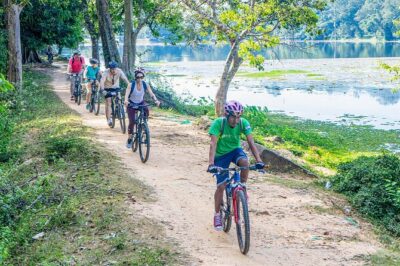
Cycle the Angkor Backroads with lunch / E-Bike or Tuk Tuk
Read our review →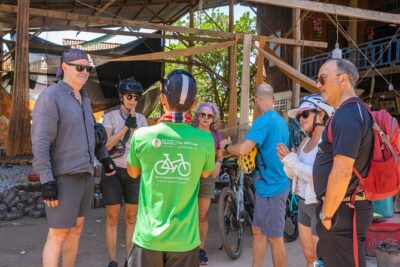
Floating Village Bike & Boat Sunset / E-Bike Available
Read our review →Browse the lists this tour appears in