
Reviewed · TONLE SAP FLOATING VILLAGE TOURS
Bakong Temples & Floating Village Tour
The most unusual part of this Siem Reap day is the contrast: Bakong is the first Khmer temple-mountain, while Kampong Phluk is a living community built around changing water levels. You move from ancient stone towers and elephant guardians to homes, schools, and shops that float or rise high on stilts.
I like the private format and the way the tour joins three quieter Roluos temples with a boat trip on Tonle Sap. I also like having an English-speaking guide such as Mr K, known for clear explanations and an easy manner, or Mr Oun Kosorl, whose enthusiasm for Angkor’s temples comes through strongly. The main catch is cost: the $45 tour price does not include the $37 Angkor Pass or the floating village admission.
Key points to know before booking
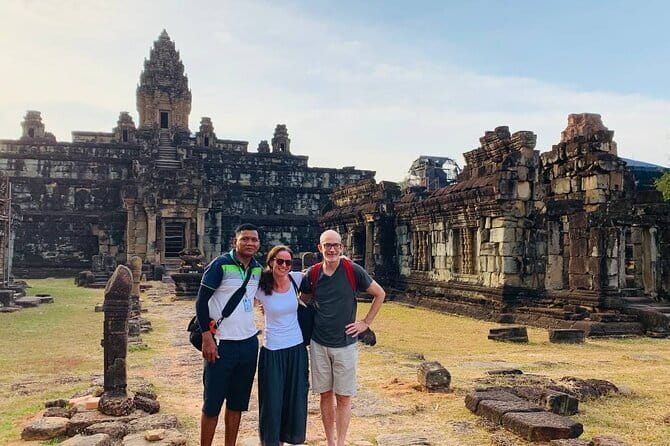
- Bakong gives you an early model of Angkor Wat: Its five-level sandstone pyramid represents Mount Meru and helps explain the temple-mountain design that came later.
- Kampong Phluk is a working community, not a staged attraction: You see homes, schools, and shops adapted to seasonal water levels.
- The tour is private: Only your group takes part, with pickup and drop-off in an air-conditioned vehicle.
- The three Roluos temples create a useful progression: Lolei, Preah Ko, and Bakong show important early Khmer building styles in one day.
- Budget for the extra fees: The Angkor Pass is listed at $37 per person, and admission for the floating village is also not included.
- Allow most of a day: The experience lasts about 6 to 8 hours, with roughly three hours at Kampong Phluk and two hours at Bakong.
Why the Roluos temples are worth your morning
Many people race straight to Angkor Wat and miss the earlier temples that explain how Khmer sacred architecture developed. This tour takes you southeast of the main Angkor complex to the Roluos group, where Lolei, Preah Ko, and Bakong mark an important early chapter in the Khmer Empire.
The stops are close enough to form a sensible half-day circuit, but each one has a different role. You are not simply looking at three piles of old stone. You are seeing the change from earlier brick temples to the large sandstone temple-mountain that later rulers would refine.
The order also helps. Lolei introduces the group, Preah Ko adds another early Hindu temple, and Bakong gives you the biggest architectural idea of the morning. A good guide can connect the sites rather than treating each as an isolated photo stop.
Your guide matters here. Mr K is described as charming and insightful about Siem Reap and its temples, while Mr Oun Kosorl is especially praised for his enthusiasm for Angkor’s story. Ask your guide to point out what changes from one temple to the next. That question can turn a short visit into a useful lesson in Khmer design.
More Tonle Sap floating village trips in Siem Reap:
- From Siem Reap: Kampong Phluk Floating Village Tour by Boat
★ 4.9 · 6,979 reviews - Sunset tour of Kampong Phluk stilts home village on the Tonle Sap
★ 5.0 · 4,865 reviews - Kompong Phluk Floating Village Half-Day Tour ( Morning / Sunset )
★ 5.0 · 1,494 reviews
Lolei, an early temple with a quiet setting
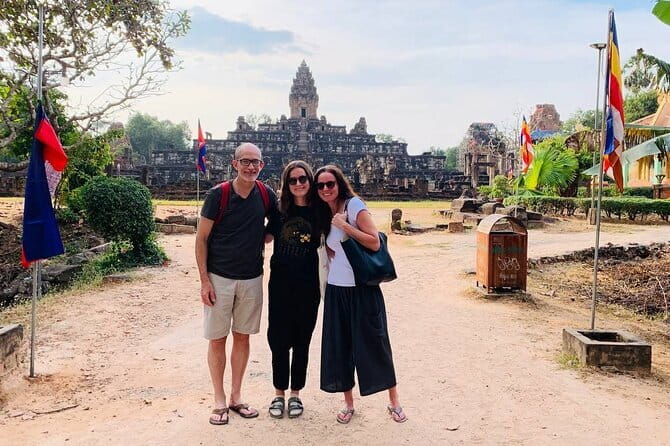
Lolei is the northernmost of the three Roluos temples. It dates to the late ninth century and belongs to the period when the ancient city of Hariharalaya was an important center of Khmer power.
You spend about an hour here, which gives you time to look at the temple without feeling rushed. The admission ticket is not included, so keep the extra cost in mind when comparing this tour with a temple-only outing.
Lolei is best approached as a starting point. Its importance comes from its place in the early Roluos group and from the way it sets up the architectural story that Bakong completes. You might find the site less immediately dramatic than Bakong, but that is part of the point. The morning begins with an early form before moving toward the larger temple-mountain.
Your guide can also give you historical context that is hard to pick up from the stones alone. If you prefer grand views and famous monuments at every stop, Lolei may feel modest. If you want to understand the sequence of Khmer temple building, the hour is well spent.
Preah Ko and the foundations of Hariharalaya
Preah Ko was the first temple built in the ancient city of Hariharalaya, about 15 kilometers southeast of the main Angkor temple group. That location gives the stop a useful sense of place. You are not just visiting an outlying ruin. You are seeing part of an earlier urban and religious center.
The visit lasts about an hour, and admission is listed as free. Compared with Bakong, Preah Ko is a smaller and more focused stop, but it helps you see how the Roluos group worked as a set of temples rather than one grand monument.
I would listen closely during this part of the tour. The value comes less from a single spectacular feature and more from the connection between site, period, and design. The English-speaking guide can explain why this temple matters before you reach the morning’s main event.
Because the tour is private, you can ask for more time here if the early Khmer period interests you, or keep moving if you are eager to reach Bakong. That flexibility is one of the better reasons to choose a private tour instead of a fixed group schedule.
Bakong’s five levels and stone guardians
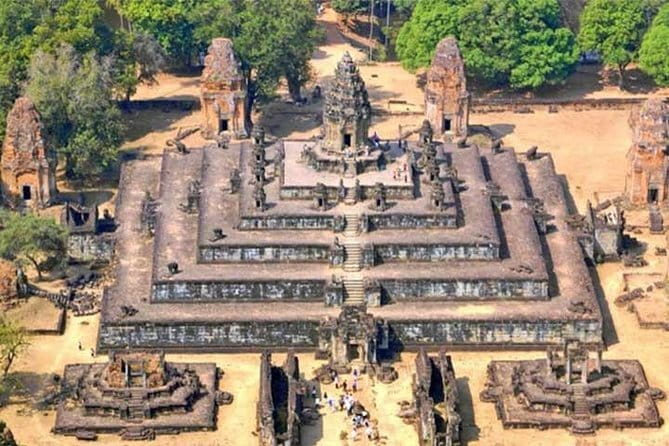
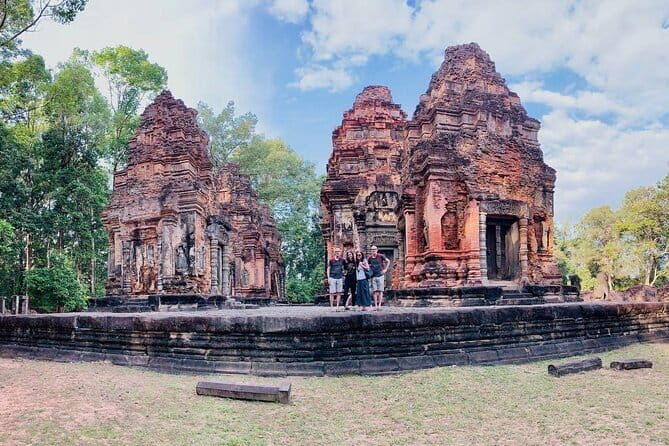
Bakong is the centerpiece of the temple portion. Built in 881 AD by King Indravarman I, it is described as the first Khmer temple-mountain constructed from sandstone. Its design became a model for later Khmer monuments, including Angkor Wat.
You spend about two hours here, and that longer visit makes sense. Bakong is not a single tower to photograph and leave behind. Its five-tiered pyramid represents Mount Meru, the sacred mountain at the center of Hindu and Buddhist cosmology. Moats and enclosing walls reinforce that symbolic idea, separating the sacred center from the world outside.
Look for the earliest known example of a Naga causeway in Khmer architecture. Also pay attention to the large stone guardian statues of elephants and lions on the lower levels. These figures give the base a physical, protective quality and are among Bakong’s most distinctive details.
The sandstone is important, too. Seeing Bakong after Lolei and Preah Ko helps you understand the shift in construction and ambition. The temple feels like a major statement, yet it remains easier to take in than a huge circuit of Angkor monuments.
You should expect uneven stone surfaces and some walking around the pyramid. The supplied information does not specify accessibility details, so ask the operator if you have mobility concerns. Two hours is enough to look carefully, but the heat can affect how much energy you want to spend climbing or walking around the lower levels.
More countryside and village tours in Siem Reap:
- Kampong Phluk Floating Village Tour by Boat
★ 5.0 · 1,020 reviews - Siem Reap Countryside Bike Tour / E-Bike or Tuk Tuk
★ 5.0 · 935 reviews - Siem Reap: Tonle Sap, Kampong Phluk & Floating Village Tour
★ 4.4 · 397 reviews - Siem Reap: Cambodian Pottery Class
★ 4.9 · 339 reviews
Crossing from temple stones to Tonle Sap
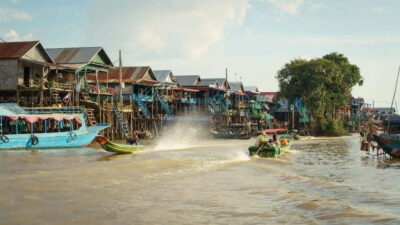
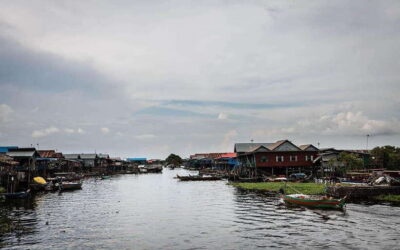
After the temples, the tour turns to Kampong Phluk Floating Village, a very different kind of place. The village sits within the Tonle Sap system, the largest lake in Southeast Asia, which covers parts of five Cambodian provinces.
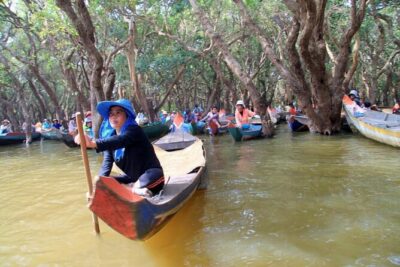
The boat ride is central to the experience. One account describes traveling along the river to reach the village, where the community includes a school for grade-school children learning English. That detail matters because it puts daily life at the center of the visit rather than treating the village as scenery.
Kampong Phluk is built to adjust to seasonal water levels. Some homes and structures float directly on the water. Others stand on tall stilts, which rise far above the ground during the dry season. This changing arrangement is one of the most interesting parts of the visit. You are seeing architecture shaped by the water, not simply buildings placed beside it.
The village also has community infrastructure on the water, including homes, schools, and shops. The result is a place where movement, work, education, and family life all connect to the lake and river system.
What the three-hour village visit feels like
The village portion takes about three hours, so it is not a quick photo stop. You have time to understand how the settlement works and to see more than one type of structure.
You may find the conditions difficult to take in. The village reflects a hard way of life, and the contrast between the homes, the water, and the seasonal changes can be sobering. At the same time, the community is presented as active and self-contained, with people carrying on ordinary life through schools, shops, and homes.
That balance is important. Go with respect and curiosity rather than expecting a polished sightseeing attraction. Keep your attention on the community’s structure and adaptation. The floating homes, stilted buildings, and river approach tell you more than a quick stop for photographs.
Weather can shape the experience. One account describes an unlucky day because of poor weather, so you should be prepared for conditions that may affect the boat ride and visibility. The provided details do not specify the boat type or weather arrangements, so ask the operator if those points matter to you.
The village visit may be the strongest part for you if you want to see how people live in Cambodia today. If your main interest is temple architecture, the three-hour visit may feel long compared with the archaeological stops. That is the central choice this tour asks you to make.
The private format and what is included
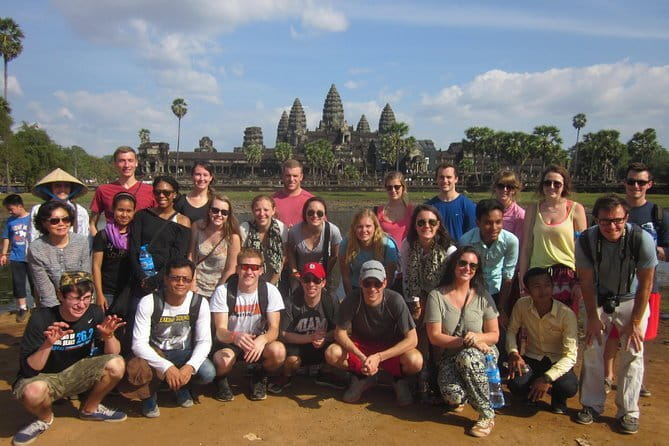
This is a private activity, so only your group participates. That gives you a more personal pace than a large coach tour and makes it easier to ask your guide about temple details or daily life at the village.
Pickup and drop-off are included, along with an air-conditioned vehicle and cold drinking water. Those basics matter in Siem Reap, where a long temple morning followed by a village excursion can be tiring. You do not need to arrange separate transport between the temples and the lake.
The tour lasts about 6 to 8 hours. The exact length can depend on the pace of your group and the time spent at each stop. With one hour at Lolei, one hour at Preah Ko, two hours at Bakong, and three hours at Kampong Phluk, this is a full day rather than a short add-on.
Group discounts are offered, and a mobile ticket is available. The tour is booked, on average, about 12 days ahead, so I would not leave it until the last moment if the private format and specific date are important to you.
Is $45 a fair price?
At $45 per person, the base price is reasonable for a private 6 to 8-hour tour with hotel pickup, drop-off, air-conditioned transport, an English-speaking guide, and drinking water. The value is strongest when you are sharing the cost with family or friends, since the private vehicle and guide serve only your group.
You must budget beyond the advertised price. The $37 Angkor Pass per person is not included. Admission for the floating village is also not included, while Preah Ko and Bakong are listed as free stops in the tour details. Since the fee information is split between the stops and the overall tour notes, confirm exactly which tickets the operator will collect or which you must buy yourself.
That extra cost does not make the tour poor value, but it changes the real price. Add the temple pass and village admission before comparing it with other private Siem Reap day tours. The convenience of transport and a guide can still make the package worthwhile, especially if you want both early temples and Tonle Sap in one day.
Free cancellation is available if you cancel at least 24 hours before the start time. Changes or cancellations inside that period are not refunded.
Who will get the most from this day
I would choose this tour if you want two kinds of Cambodian experience in one outing: early Khmer temple architecture and a close look at a water-based community. It suits couples, families, and small groups who value a private vehicle and the ability to ask questions along the way.
It is also a good match if you have already seen the central Angkor temples and want something different from the usual circuit. Bakong has genuine architectural importance, while Kampong Phluk adds a present-day view of life shaped by Tonle Sap.
You may want another tour if your priority is only the most famous temples, or if you prefer a short, tightly timed excursion. The village segment takes three hours, and the extra fees mean the final cost is higher than the $45 headline price.
Should you book the Bakong and floating village tour?
Book it if you want a private, full-day outing that links the first Khmer temple-mountain with a living community on the water. The strongest reasons are Bakong’s five-tiered sandstone design, the early Naga causeway, the elephant and lion guardians, and the chance to see homes, schools, and shops adapted to seasonal flooding.
Before paying, confirm the total admission cost and ask about the boat arrangements if weather or water conditions matter to you. If you are comfortable with a long day and a thoughtful look at both ancient architecture and present-day life, this is a well-balanced choice for exploring beyond the standard Angkor Wat route.
FAQ
How long does the Bakong Temples and Floating Village Tour last?
The tour lasts approximately 6 to 8 hours. The planned stops include one hour at Lolei, one hour at Preah Ko, two hours at Bakong, and three hours at Kampong Phluk Floating Village.
Is pickup and drop-off included?
Yes. Pickup and drop-off are included, along with an air-conditioned vehicle and cold drinking water.
Is this a private tour?
Yes. Only your group participates in the activity.
Is the Angkor Pass included in the $45 price?
No. The tour information lists the Angkor Pass at $37 per person and says it is not included.
Is floating village admission included?
No. Admission for Kampong Phluk Floating Village is not included. The supplied details do not state the exact additional fee.
Can I cancel for a full refund?
Yes, if you cancel at least 24 hours before the experience start time. Cancellations or changes made less than 24 hours before the start time are not refunded or accepted.
Just added around Siem Reap
- Ultimate Sunrise to Angkor Wat, Angkor Thom and Bayon Temple★ 5.0 · 3 reviews
- Full-Day Private Tour of Angkor Wat with Pick Up★ 5.0 · 12 reviews
- Trekking Tour at Phnom Kulen National Park from Siem Reap★ 5.0 · 3 reviews
- Twilight Tastes of Siem Reap Include Dinner★ 5.0 · 13 reviews
- Private Day Trip to Angkor Temples with Expert Guide★ 5.0 · 4 reviews
- Waterfall & River of 1000 Siva Linga- Kulen Mountain Private Tour★ 5.0 · 3 reviews
- Siem Reap City Tour with War Museum and Killing Field★ 5.0 · 27 reviews
- Private Two Days Siem Reap Temples Discovery Guided Tour★ 5.0 · 7 reviews
Tonle Sap Floating Village Tours, compared.
Sunset tour of Kampong Phluk stilts home village on the Tonle Sap
Read our review →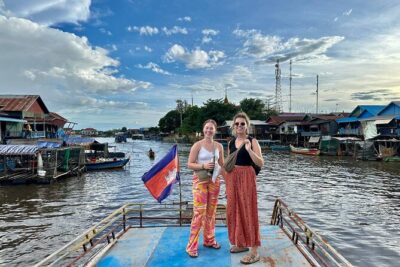
Kompong Phluk Floating Village Half-Day Tour ( Morning / Sunset )
Read our review →
Kulen Mountain, Beng Mealea and Tonle Sap Tour
Read our review →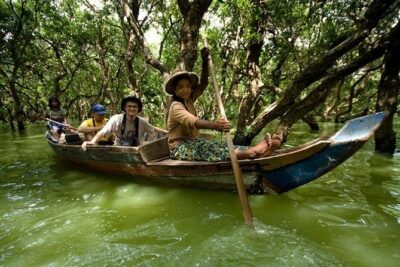
Tonle Sap Lake & Kampong Phluk Village Half-Day Tour
Read our review →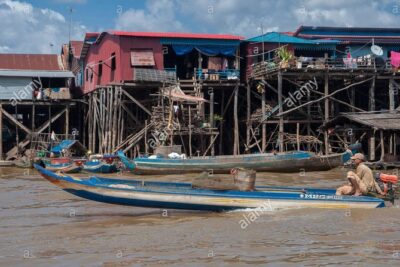
Kulen Mountain with Beng Mealea and Tonle Sap Small Group Tour
Read our review →Browse the lists this tour appears in