
Reviewed · ANGKOR SUNSET TOURS
Preah Khan, Neak Pean and Pre-Rup Private Tour
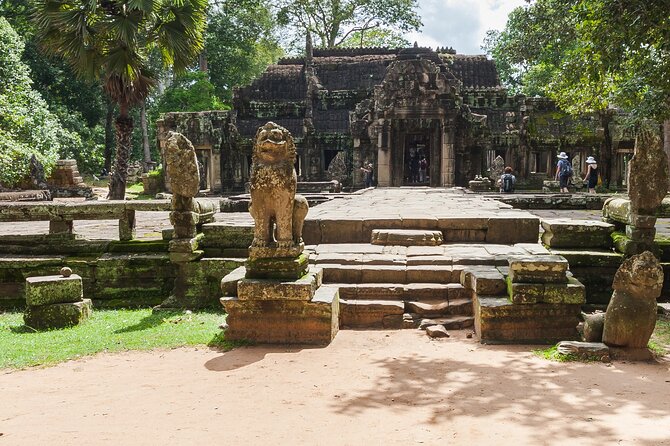
The most appealing part of this tour is its spread of lesser-visited Angkor sites. Instead of spending another day at Angkor Wat, you move through royal temples, an island shrine, old reservoirs, and forest-framed ruins, with enough time at six different stops to see how varied the Angkor complex can be.
I like the private vehicle and flexible attention from the guide, especially for families or small groups. I also like the route itself: Preah Khan supplies the scale, Neak Pean and Srah Srang add water and reflection, and Ta Som gives you a smaller, more intimate temple stop. The main drawback is cost. The tour is $41 per person, but the stated entrance charge for Preah Khan is another $37 per person, so you should budget at least $78 per person before booking.
Key points to know
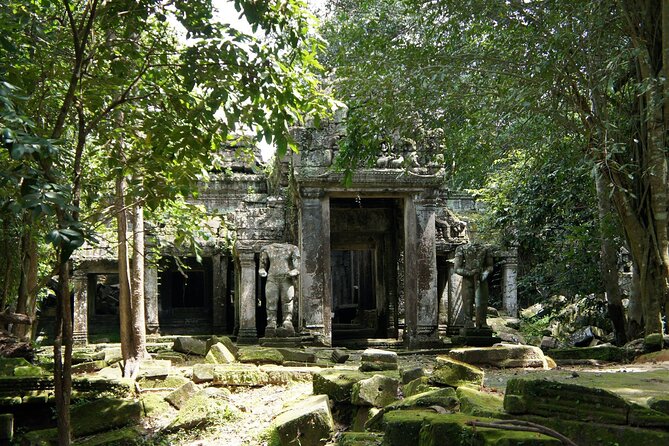
- Six distinct Angkor sites: Preah Khan, Neak Pean, Ta Som, East Mebon, Srah Srang, and Pre Rup are covered in roughly four to five hours.
- Private touring: Only your group participates, with hotel pickup and drop-off in an air-conditioned vehicle.
- Guide Sim is specifically praised: Sim guided one group through the outer temples and adjusted the plan when the family had already visited one site.
- The route balances famous and quiet places: Preah Khan is large and important, while Ta Som and Neak Pean feel more focused and compact.
- Entrance costs need attention: The tour price does not include the listed $37 Preah Khan admission charge.
- Good for a second Angkor day: It fills in the temples beyond the main Angkor Wat and Angkor Thom circuit.
Why this makes a good second day in Siem Reap
This tour works best after you have already seen Siem Reap’s headline temples. The route takes you beyond the most familiar Angkor stops and gives you a wider sense of the Khmer building program.
You will not spend the entire morning at one giant monument. Instead, the tour moves through six places with different moods and designs. Preah Khan is broad and layered. Neak Pean is reached across a long causeway over a reservoir. Ta Som is smaller, with trees pressing close to the stone. East Mebon rises from the center of a reservoir that is now dry, while Srah Srang brings you back to open water. Pre Rup finishes the circuit with a strongly vertical temple mountain.
That variety matters. If you visit only the largest temples, it is easy to think Angkor is simply a collection of towering stone structures. This route shows you the old water system, royal memorial temples, Buddhist sanctuaries, brick construction, laterite platforms, and different approaches to sacred space.
The tour lasts about four to five hours. That is enough time for a useful overview, but not enough for long, unhurried exploration at every site. You should expect a brisk half-day rather than a slow archaeological study.
More small and grand circuit tours in Siem Reap:
- 2-Day Angkor Wat With Small, Big Circuit and Banteay Srei Tour
★ 5.0 · 545 reviews - Full-Day ‘Big Tour’ with Sunset at Phnom Bakheng
★ 5.0 · 341 reviews - Private sunrise ‘small tour’ of Angkor Wat with car or van & Guide
★ 5.0 · 179 reviews
Preah Khan gives the morning its scale

Preah Khan is the major stop, and the one place here where the stated admission fee applies. Built in the 12th century by King Jayavarman VII to honor his father, it follows a flat, rectangular plan with successive galleries.
That layout makes Preah Khan feel different from a temple mountain such as Pre Rup. You move through one enclosure after another, with doorways and corridors drawing you forward. The site is large enough to reward a guide who can explain what you are seeing instead of simply pointing out carvings.
Allow about one hour here. That is a sensible amount of time for a guided visit, though you may want longer if you enjoy architectural details or photography. The temple’s size can also make the stop feel busy in your mind, so listen for the guide’s explanation of the plan and purpose. It will help you understand how the separate galleries fit together.
The practical issue is the admission fee. The tour information lists $37 per person for Preah Khan, while the tour price itself is $41. That makes the entrance cost nearly as large as the tour cost. Confirm exactly how the fee is handled before departure, and build it into your budget.
Still, Preah Khan is a strong first stop. It gives you the grand scale that many people expect from Angkor, then the rest of the route can focus on smaller and more unusual places.
Neak Pean turns the temple visit into a walk over water
Neak Pean, also called Neak Poan, means the entwined serpents. The temple sits on an artificial island in the middle of a large reservoir associated with Preah Khan.
The reservoir is described as about 3.5 kilometers by 1 kilometer, so the setting is as important as the shrine itself. You approach across the water rather than arriving directly beside a broad stone entrance. That short transition changes the pace of the tour after Preah Khan’s enclosed galleries.
The temple was built by King Jayavarman VII. Your guide can connect it to the wider hydraulic and religious system around Preah Khan, helping you see why the reservoir was not just a decorative backdrop.
Neak Pean receives about an hour on this route. That may feel generous for a compact temple, but the extra time allows you to appreciate the approach, the artificial island, and the relationship between the shrine and water. It is also one of the easier stops for taking a breath between larger sites.
The tradeoff is that the main structure is not as extensive as Preah Khan. If you want room after room of carvings, this will feel brief. If you like unusual settings and clear visual contrasts, it earns its place.
Ta Som offers the most intimate temple setting
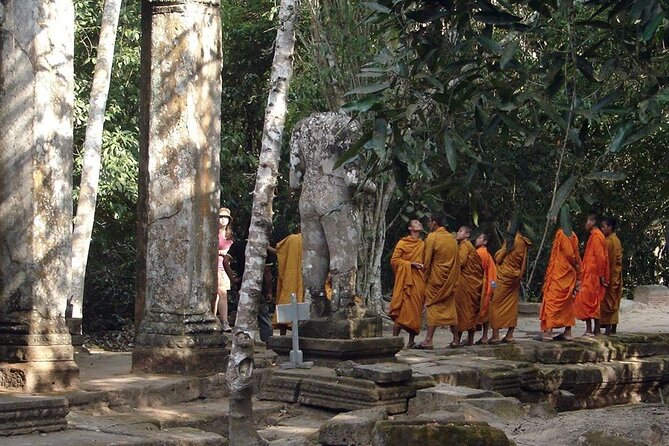
Ta Som is a smaller temple northeast of Angkor Thom and east of Neak Pean. King Jayavarman VII built it at the end of the 12th century and dedicated it to his father, Dharanindravarman II.
You get about 30 minutes here. That is enough for a focused visit, especially after the longer stops. Ta Som is framed by forest and jungle, giving it a more enclosed, quiet character than the wide reservoir sites.
I would pay attention to the scale. Ta Som does not try to overwhelm you with size. Its appeal comes from the way stone and trees meet, and from the sense that you are seeing a smaller part of the Angkor plan rather than another central royal monument.
This is also one of the stops where a private tour can help. A guide can keep the visit moving while pointing out the parts worth noticing. Sim, one of the guides associated with this tour, was praised for helping a family adjust the day when they had already visited one temple. That kind of flexibility is useful here, since a small site does not require the same time as Preah Khan.
More sunset temple tours in Siem Reap:
- Angkor Wat Sunrise or Sunset Tour with Guide from Siem Reap
★ 5.0 · 12,109 reviews - Siem Reap: Angkor Wat: Small-Group Sunrise or Sunset Tour
★ 5.0 · 9,444 reviews - Siem Reap: Angkor Wat 2-Day Tour with Sunrise and Sunset
★ 4.9 · 4,429 reviews - Angkor Wat Sunset Small Group Tour with Lunch Included
★ 5.0 · 3,059 reviews
East Mebon explains the old reservoir system
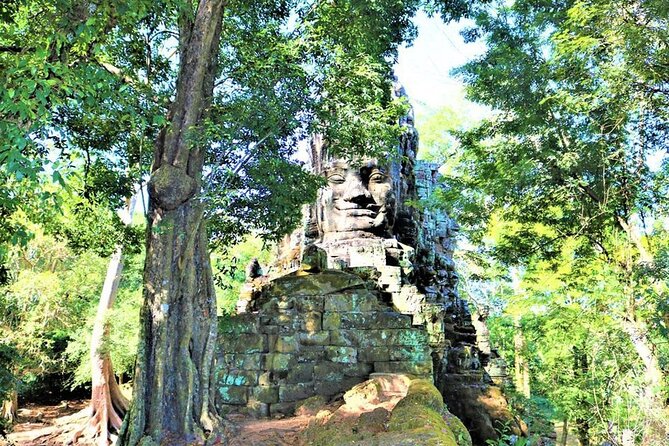
East Mebon was built in the 10th century by King Rajendravarman. It once occupied an artificial island in the center of the East Baray, a reservoir described as about 7.5 kilometers by 1.8 kilometers.
Today, the reservoir is dry. That difference gives the stop an educational edge. You can look at the temple and imagine its original relationship with a huge body of water, rather than seeing it only as an isolated ruin.
The temple is built in an earlier period than Preah Khan and adds useful contrast to the route. You are no longer looking only at Jayavarman VII’s 12th-century projects. East Mebon helps show how Angkor changed over time, both in royal patronage and in the use of brick, laterite, and sandstone.
The visit lasts about 40 minutes. That is long enough for a guided walk around the main features without making the stop feel drawn out. If reservoirs and infrastructure interest you, this may be one of the most valuable stops. If you are focused only on dramatic towers, it may seem less immediately impressive.
Srah Srang brings open space and water
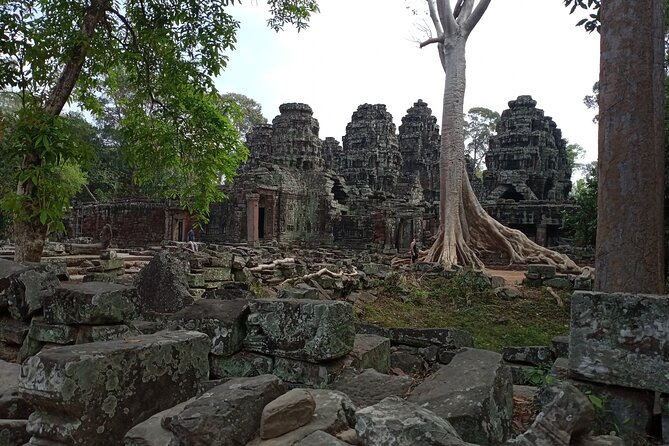
Srah Srang is a large reservoir dug in the mid-10th century at the initiative of Kavindrarimathana, a Buddhist minister of Rajendravarman II. Around 1200, Jayavarman VII modified it and added the laterite landing platform.
You spend about 20 minutes here. That short stop makes sense. Srah Srang is more about the view, the water, and the reservoir’s role in the Angkor setting than about walking through a large temple complex.
After the enclosed passages of Preah Khan and the compact shrine at Ta Som, the open water gives the route a change of rhythm. You can pause, listen to the guide’s explanation, and take in the scale of the old reservoir system.
Do not expect a long temple visit at Srah Srang. The attraction is the setting and the history of the waterworks. It works well as a brief stop on a route that already contains several substantial ruins.
Pre Rup finishes with brick, laterite, and height
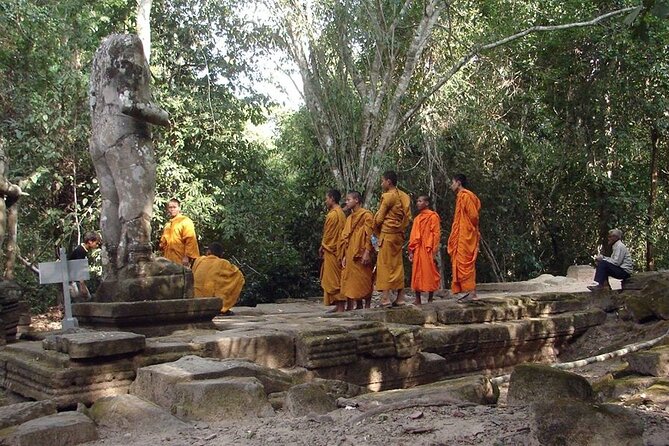
Pre Rup was built by King Rajendravarman in the 10th century. It is a temple mountain made from brick, laterite, and sandstone. The name is comparatively modern and means turning the body.
The tour allows about 40 minutes here. Pre Rup gives the day a strong finish because its design draws your eye upward. After several flat or low-lying sites, you end at a more vertical structure with a clear sense of ascent.
The building materials also make it a useful final comparison. Preah Khan’s long galleries, Neak Pean’s island setting, East Mebon’s reservoir connection, and Pre Rup’s brick and laterite construction all show different solutions to temple design.
The information provided does not promise a sunset visit, so do not book this tour expecting a specific sunset experience. Treat Pre Rup as the final architectural stop, not as a guaranteed evening event.
What the private format adds
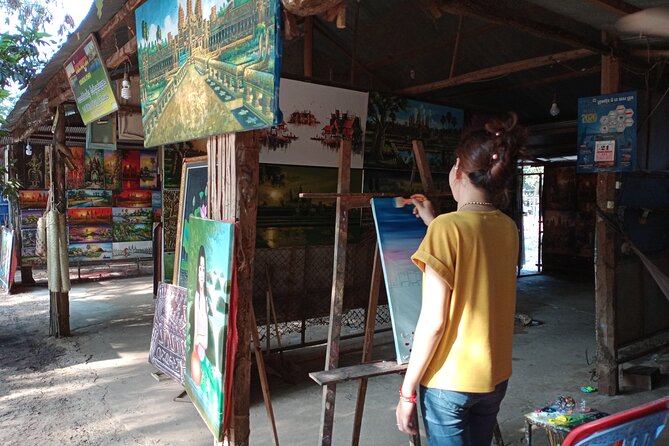
The private setup is one of the tour’s strongest practical features. Only your own group participates, and transport is provided in a private air-conditioned vehicle. Hotel pickup and drop-off are included, along with bottled water.
That matters in Siem Reap’s heat. Six temple stops can become tiring, and the vehicle gives you a place to cool down between walks. It also keeps the day simpler than arranging separate rides for each site.
A private guide can explain the history, culture, and Cambodian way of life as you move through the temples. The experience depends heavily on the guide you receive, but Sim is specifically named in the feedback and was praised for his explanations and helpful approach.
The private format can also help if your group has mixed interests. Someone may want more time at Preah Khan, while another person may prefer to keep moving. The tour is not advertised as fully customizable, but the account of Sim adapting the route after a temple had already been visited suggests that some practical adjustment is possible.
Price, timing, and who gets the best value
The listed price is $41 per person. That sounds reasonable for a private half-day tour with transport, an English-speaking guide, hotel transfers, and water. The value becomes less straightforward once you add the stated $37 admission charge for Preah Khan.
At a minimum, think of the cost as $78 per person based on the supplied figures. The tour may still be worthwhile if you value private transport and an organized route, but you should compare that total with your other Angkor plans before booking.
This tour suits you best if:
- You have already visited the main Angkor Wat area.
- You want six sites in one compact outing.
- You prefer a private vehicle to arranging transport yourself.
- You enjoy historical explanation rather than simply taking photos.
- Your group includes family members or friends who benefit from a private pace.
- You want a guide who can adjust the day when one stop is already familiar.
It may not suit you if you want a slow visit at every temple. The schedule gives you one hour at the two biggest early stops, but only 20 to 40 minutes at several others. You will see a lot, but you will not have unlimited time for every corridor, carving, or photograph.
The tour has a five-star rating from seven reviews, and the most consistent praise centers on the guides, especially Sim. That is useful, but it is still a small number of reviews. I would treat the guide quality as a strong reason to consider the tour, not as a guarantee of who will lead your group.
Free cancellation is available up to 24 hours before the start time. Changes or cancellations inside that window are not accepted for a refund. The tour is near public transportation, and the information says most people can participate.
Should you book this Angkor temple tour?
Book it if you want a well-organized second day around Angkor, with a private vehicle and a route that mixes large temples, waterworks, forest ruins, and a temple mountain. Preah Khan and Neak Pean provide the strongest visual variety, while East Mebon and Srah Srang add context about the reservoirs that supported the ancient city.
Before paying, confirm the entrance arrangement and remember the extra $37 charge listed for Preah Khan. If the total fits your budget, this is a practical way to see the outer temples without arranging transport stop by stop.
Skip it if your priority is spending a full morning at one or two major temples. For most people seeking breadth, a private guide, and a half-day route beyond the usual Angkor highlights, it is a sensible choice.
FAQ
How long does the tour last?
The tour lasts approximately four to five hours.
Is hotel pickup included?
Yes. Hotel pickup and drop-off are included.
Is the tour private?
Yes. Only your group participates in the activity.
Is transportation provided?
Yes. The tour includes a private air-conditioned vehicle.
Is an English-speaking guide included?
Yes. An English-speaking tour guide is included. Sim is one guide associated with the experience.
Which temples and sites are visited?
The route includes Preah Khan, Neak Pean, Ta Som, East Mebon, Srah Srang, and Pre Rup.
Are entrance fees included?
No. The stated information lists a $37 per-person admission fee for Preah Khan as not included.
Can I cancel for a full refund?
Yes, if you cancel at least 24 hours before the experience start time. Cancellations made less than 24 hours before the start time are not refunded.
Just added around Siem Reap
- Ultimate Sunrise to Angkor Wat, Angkor Thom and Bayon Temple★ 5.0 · 3 reviews
- Twilight Tastes of Siem Reap Include Dinner★ 5.0 · 13 reviews
- Full-Day Private Tour of Angkor Wat with Pick Up★ 5.0 · 12 reviews
- Trekking Tour at Phnom Kulen National Park from Siem Reap★ 5.0 · 3 reviews
- Siem Reap City Tour with War Museum and Killing Field★ 5.0 · 27 reviews
- Private Day Trip to Angkor Temples with Expert Guide★ 5.0 · 4 reviews
- Waterfall & River of 1000 Siva Linga- Kulen Mountain Private Tour★ 5.0 · 3 reviews
- Private Two Days Siem Reap Temples Discovery Guided Tour★ 5.0 · 7 reviews
Angkor Sunset Tours, compared.
Angkor Wat Sunrise or Sunset Tour with Guide from Siem Reap
Read our review →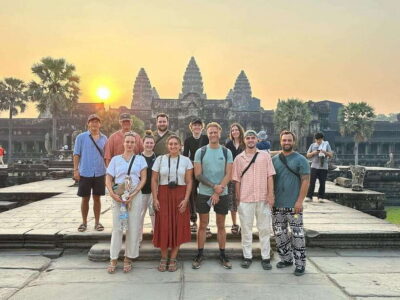
Angkor Wat: Small-Group Sunrise or Sunset Tour
Read our review →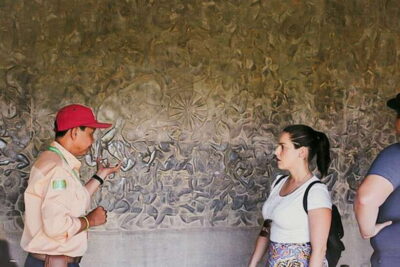
Angkor Wat 2-Day Tour with Sunrise and Sunset
Read our review →
Angkor Wat Sunset Small Group Tour with Lunch Included
Read our review →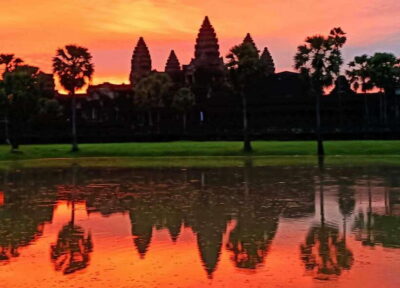
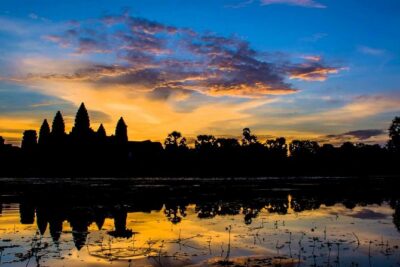

2 Days Exclusive Temple Highlights with Sunset and Sunrise Tour
Read our review →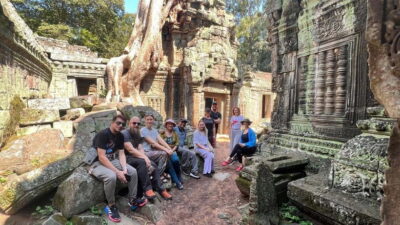
2-Day Temple Highlights Sunrise and Sunset Option
Read our review →Browse the lists this tour appears in