
Reviewed · ANGKOR WAT TOURS
3-Day Angkor Wat with All Interesting Major Temples, Banteay Srei & Beng Mealea
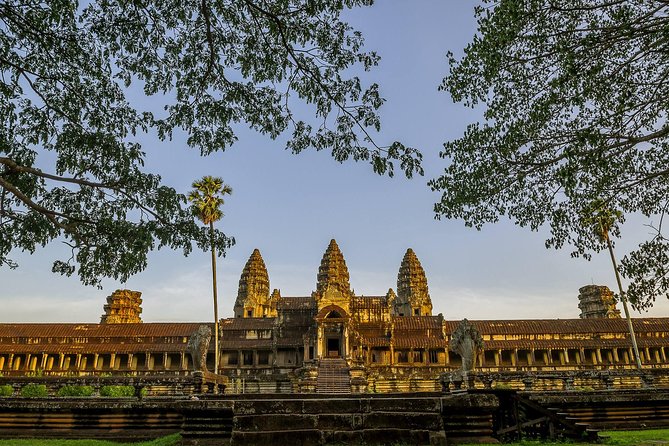
Angkor Wat is only the opening act here. Over three full days, you move from the famous temple itself to jungle-covered Beng Mealea, finely carved Banteay Srei, quiet Ta Nei, and the early Roluos temples. The tour also gives you both a sunset at Phnom Bakheng and a very early sunrise at Angkor Wat.
I like the private transport and hotel pickup, which remove the daily hassle of arranging rides around Siem Reap. I also like the guide-led approach: guides such as Mony, Vanna, Mr. Khmer, Thou, Chen, and others have been praised for explaining carvings, religious ideas, construction, and local life. The main drawback is the pace. Three days cover a huge number of sites, and the 5:00am start, long walks, heat, and 68-kilometer trip to Beng Mealea make this a serious temple schedule rather than a gentle holiday outing.
The tour in six useful points
- Three private days cover far more than Angkor Wat, including the main Angkor circuits, Banteay Srei, Beng Mealea, and the Roluos Group.
- Day two begins at 5:00am for sunrise, then continues through Preah Khan, Neak Pean, Ta Som, East Mebon, Pre Rup, and more.
- Phnom Bakheng sunset is not guaranteed, since access is limited and you may need to wait for a place.
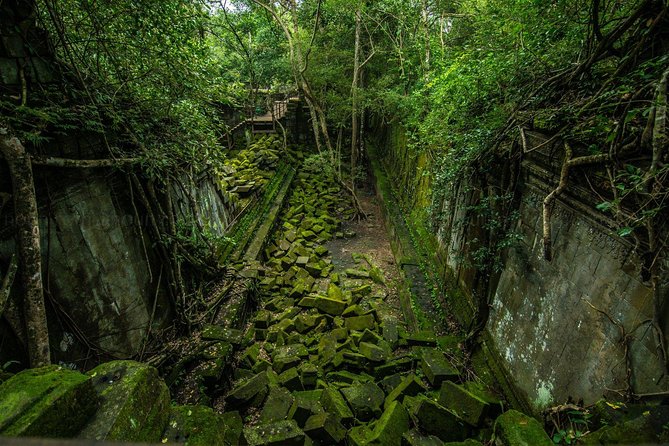
- Beng Mealea adds a different kind of temple experience, with collapsed stonework and jungle growth about 68 kilometers northeast of Siem Reap.
- The $261 price does not include the temple pass or lunches, so budget another $62 for the Angkor admission and about $5 per lunch.
- The tour suits history-minded visitors who want a private guide, but you should be ready for early mornings, stairs, heat, and long sightseeing days.
What the $261 price really buys you
The listed cost is $261 per person. That includes a private, air-conditioned vehicle, a licensed English-speaking guide, hotel pickup and return in Siem Reap, road tolls, parking, cool drinking water, and cold wet towels.
The important extra is the temple admission. Angkor Wat and the other temples require a pass costing $62 per person, and that is not included. Lunch is also separate. The stated guide is around $5 per person at a restaurant along the route, depending on what you order.
That makes the tour better value for you if you want a guide and dedicated transport for three days. You are not paying only for a ride to Angkor Wat. You are paying for route planning, temple explanations, return transport, and access to places that are awkward to combine independently, especially Beng Mealea and the Roluos temples.
The private format matters. Only your group participates, so you can ask questions and adjust small parts of the day. The itinerary also says that Phnom Bakheng sunset, Artisans Angkor, and the Old Market can be skipped if you prefer to finish earlier or return to the hotel.
More Beng Mealea jungle temple tours in Siem Reap:
- Siem Reap: Kulen Mountain, Beng Mealea and Tonle Sap Tour
★ 5.0 · 1,483 reviews - Kulen Mountain with Beng Mealea and Tonle Sap Small Group Tour
★ 5.0 · 780 reviews - Koh Ker Temple Group & Beng Mealea Full-Day Join-in Tour
★ 5.0 · 710 reviews
Day one: Angkor Wat, jungle roots, and Angkor Thom
The first pickup is scheduled for 8:00am, which gives you a more reasonable start than the sunrise morning still ahead. On the way to the temples, the guide takes you to buy the required temple pass if you do not already have one.
Angkor Wat needs time, not a quick photo
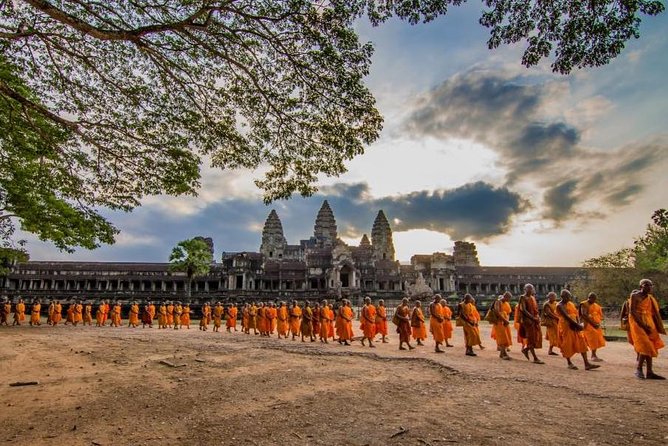
Allow about two and a half hours at Angkor Wat. That is sensible. The main temple complex is too large and detailed for a short stop, and your guide can point out the structure, carvings, religious purpose, and design instead of leaving you to wander without context.
You can expect a lot of walking and some uneven surfaces. The first day places Angkor Wat at the start, when you are still fresh, rather than tacking it onto the end of an already crowded route.
Ta Prohm brings the jungle drama
Ta Prohm takes about two hours. Its appeal is immediate: huge tree roots press over stone galleries and courtyards, creating the image many people associate with Angkor after seeing Tomb Raider.
This is one of the busiest and most photographed places on the route. The trees and ruins make it memorable, but the popularity also means the experience can feel less quiet than Ta Nei later in the day. Your guide helps turn the stop into more than a photo session by explaining the temple’s Buddhist setting and place in the Angkor complex.
More Banteay Srei tours in Siem Reap:
- Full-Day Banteay Srei & 4 Temples – Grand Tours Join-in Tour
★ 5.0 · 1,155 reviews - Siem Reap Tour: Angkor Wat Sunrise, Bayon, Ta Prohm, Banteay Srei
★ 5.0 · 931 reviews - 2-Day Angkor Wat With Small, Big Circuit and Banteay Srei Tour
★ 5.0 · 545 reviews - From Siem Reap: Banteay Srei Temple & Grand 5 Temple Tour
★ 4.8 · 262 reviews
Ta Nei offers a quieter contrast
Ta Nei is a small Buddhist temple surrounded by large trees, with less restoration than the better-known sites. The stop lasts about 45 minutes.
I like this inclusion because it gives you a pause from the larger monuments. You can see how a less polished ruin feels, and the lower profile makes it useful for anyone who wants to avoid spending every hour in a crowd. Do not expect the same scale or preserved detail as Angkor Wat or Bayon. Its value is atmosphere and contrast.
Angkor Thom packs several sites into one stretch
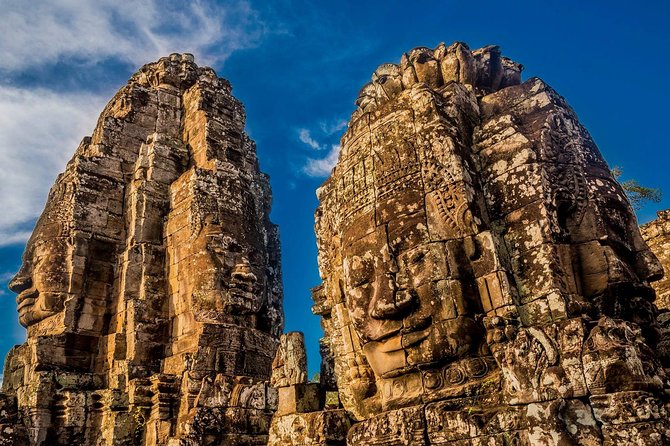
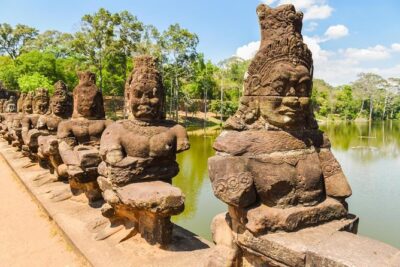
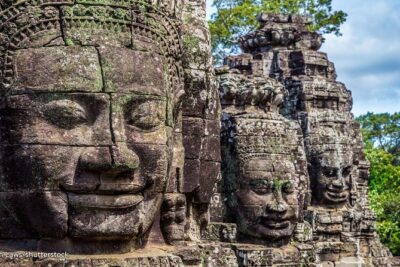
The route enters Angkor Thom through the Victory Gate, where you stop briefly for photographs before continuing to Bayon. Bayon is the heart of the old city, with 49 towers and four faces on each tower, traditionally linked with Avalokitesvara. The scale of the face towers is easier to appreciate when your guide explains how the temple fits into Jayavarman VII’s Buddhist building program.
The next stop is Baphuon, an 11th-century Hindu temple built before Angkor Wat. Behind it is a large reclining Buddha added in the 16th century. The combination is a useful reminder that these monuments changed as religious beliefs and royal priorities shifted.
Phimeanakas is smaller and more restrained. This pyramid temple dates to the 10th century and sits within the area of the former royal palace. Nearby, the ancient Royal Enclosure Wall helps you picture Angkor Thom as a functioning capital, not simply a collection of isolated ruins.
The Terrace of the Elephants takes only about 10 minutes, but its carved elephant figures and former royal viewing platform make it worth a short stop. The nearby Terrace of the Leper King is another brief visit with detailed carvings on the platform.
Phnom Bakheng ends the day with a question mark
The day finishes at Phnom Bakheng, a hilltop temple used for sunset views. The climb takes about two hours in the schedule, including waiting time.
Access is limited, so reaching the hill does not guarantee an easy sunset viewing position. You may wait for access, and you can skip this final stop if you are tired or do not want to spend more time in line. If the conditions work in your favor, the high viewpoint gives you a scenic end to a long first day.
Day two: sunrise, the Grand Circuit, and Banteay Srei
Day two starts at 5:00am. That early pickup is essential if you want to watch sunrise at Angkor Wat, but it also means you should protect your sleep the night before.
Sunrise at Angkor Wat requires stamina
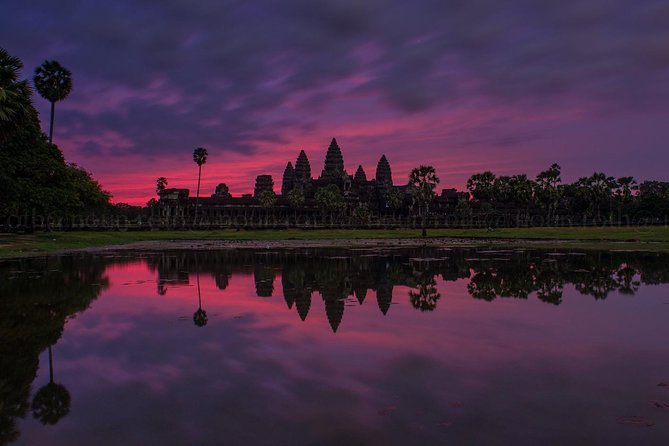
The sunrise visit lasts about one hour and 45 minutes. You see Angkor Wat in a different mood from day one, with the outline of the towers and the reflecting pools providing the classic early view.
The practical tradeoff is simple: sunrise adds atmosphere, but it does not create a shorter day. Afterward, you return to your accommodation for breakfast before meeting the guide again and continuing the circuit. You are effectively combining an early outing with another full day of temples.
Preah Khan shows the scale of a royal foundation
Preah Khan takes about an hour. This large Buddhist temple was built by Jayavarman VII and dedicated to his father. Its broad plan, corridors, and carved stonework give you a sense of how extensive royal temple foundations could be.
The stop is especially useful after the compact scenes at Angkor Wat. You can ask your guide about the temple’s religious role and the changes made over time, rather than treating it as another set of stones to photograph.
Neak Pean and Ta Som slow the pace
Neak Pean is a small island temple in the middle of the last Baray, an ancient reservoir. The stop lasts about 30 minutes and provides a change from enclosed galleries and steep temple platforms.
Ta Som takes another 30 minutes. This small Buddhist temple has a quieter feel and sits east of Neak Pean. Like Ta Nei, it is less about size than mood and detail. These shorter visits help break up the day, though the schedule leaves little room for lingering.
East Mebon and Pre Rup bring you back to temple mountains
East Mebon is a three-level temple-mountain crowned by five towers. Large elephant statues mark its corners, giving the site a strong visual identity even though the structure is now a ruin.
Pre Rup takes about an hour and dates to the late 10th century. Its name is associated with turning the body and funerary beliefs. The temple’s upper levels and Hindu dedication make it a useful counterpart to the Buddhist monuments visited earlier.
Both stops include stairs and exposed stone. By this point, the heat can matter as much as the archaeology, so use the cold water and wet towels provided, and keep your pace sensible.
Banteay Srei is the detail specialist
After lunch, the route continues to Banteay Srei, often called the Ladies Temple. The temple was built in the 10th century from pink sandstone and dedicated to Hindu deities.
This is one of the most rewarding stops for close-up carving. The smaller scale and fine sandstone decoration differ sharply from the huge blocks of Angkor Wat. You spend about an hour here, which is enough to study the ornament without turning the visit into another marathon.
Banteay Srei is also farther from the central Angkor group, so including it in a planned route saves you from working out a separate trip. The drawback is that day two already began before dawn, and the temple comes after several other stops.
Banteay Samre and Banteay Kdei close the circuit
Banteay Samre is a 12th-century Hindu temple whose design is often compared with Angkor Wat. The stop lasts about 45 minutes and provides another chance to compare temple layouts and construction styles.
Banteay Kdei is a 12th-century Buddhist temple with similarities to Ta Prohm and Bayon. You have about 45 minutes here. By the end of day two, you will have seen a wide spread of Khmer religious architecture, but you may also feel the schedule in your legs.
Day three: Beng Mealea and the first Roluos temples
Day three changes the scale and setting. Beng Mealea is about 68 kilometers northeast of Siem Reap, followed by the Roluos Group, one of the earliest clusters on the tour.
Beng Mealea is the rough-edged highlight
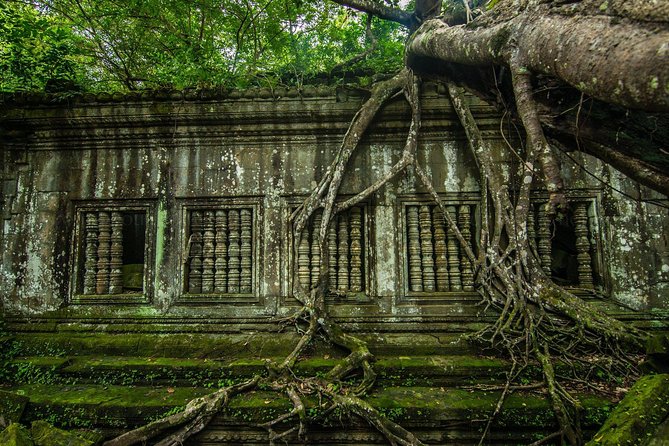
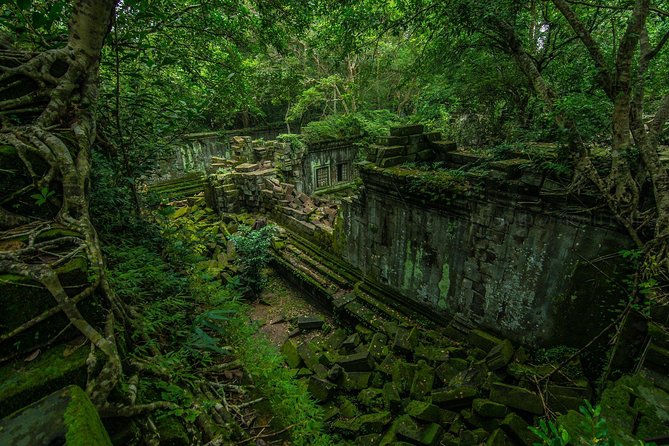
The schedule allows three and a half hours at Prasat Beng Mealea. That is a generous block, and it needs to be. The temple is large, mysterious, and heavily overrun by jungle, with nature growing through collapsed stonework.
Beng Mealea feels less controlled than the restored or carefully managed central temples. You see fallen blocks, enclosed passages, and vegetation taking back parts of the structure. If you prefer ruins with a strong sense of discovery, this may be your favorite day.
The distance is the cost. You spend more time on the road, and the stop adds a long excursion after two packed days. It is not an optional side glance at a nearby monument. It is a major part of the tour, and you should book with that in mind.
Lolei, Preah Ko, and Bakong explain the Roluos beginnings
Lolei is a small Hindu temple from the 9th century. The visit takes about 20 minutes, so it is a compact introduction to the Roluos Group.
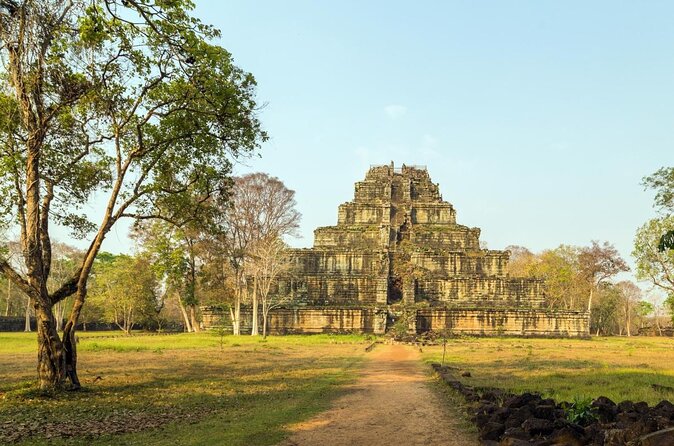
Preah Ko was the first temple built in the ancient city of Hariharalaya, now represented by the Roluos cluster. It also takes about 20 minutes. Its importance is chronological: you are seeing an earlier stage of Khmer temple building before the monumental achievements of Angkor Wat.
Bakong receives about an hour and is the largest temple in the Roluos Group. It is described as the first sandstone temple-mountain built by Khmer rulers, giving it real architectural importance even if its scale is smaller than Angkor Wat.
These sites reward explanation. Without a guide, you might simply see three more ruins. With a guide who can connect them to the development of the Khmer Empire, the morning has a clear purpose.
Optional craft and market stops
After the temples, the tour can include Artisans Angkor, known for stone carving, wood carving, lacquer work, gilding, and silk processing. You may skip it if traditional crafts are not a priority.
The final optional stop is Psar Chaa, the Old Market in central Siem Reap. It is useful if you want a quick look at a local market or need time in town, but it is not essential to the temple program. The schedule allows about 30 minutes at each optional stop.
Guides, vehicles, and the private format
The guide is one of the most important parts of this experience. The tour includes a licensed English-speaking guide, and guide assignments have included Mony, Vanna, Mr. Khmer, Thou, Chen, and others. The strongest guide experiences described for this tour involve clear explanations of temple origins, myths, carvings, construction methods, and religious meaning.
The guide can also help with practical details. One guide, for example, was praised for giving suggestions about Siem Reap and explaining Cambodian life in addition to temple history. Another was noted for photography, which can be useful at sunrise, the face towers of Bayon, and the tight spaces at Ta Prohm.
Transport is by air-conditioned vehicle with hotel pickup and return each day. That matters in Cambodia’s heat, especially on day two. Water and cool wet towels are provided, and parking fees and road tolls are covered.
Who should book this three-day plan
I would choose this tour if you want the major Angkor monuments explained in context and prefer not to manage transport yourself. It is particularly well suited to you if you enjoy architecture, religious history, carvings, and comparing temples from different periods.
It is also a good choice if you want more than the standard Angkor Wat and Ta Prohm pairing. Ta Nei, the Roluos temples, and Beng Mealea add variety, while Banteay Srei rewards attention to small details.
I would think twice if you dislike early starts, long drives, repeated stair climbing, or tightly scheduled sightseeing. The tour covers a lot because it is ambitious. A slower three-day plan could feel more restful, but it would not deliver this many major sites.
Should you book it?
Book this tour if you want a private, guide-led introduction to the full Angkor area and you value convenience more than a slow pace. The combination of sunrise, sunset, Banteay Srei, Beng Mealea, and the Roluos Group gives you a far broader view than a one-day temple outing.
Before booking, add the $62 temple pass and roughly $5 per lunch to your budget. Confirm that your group is ready for the 5:00am start and the long Beng Mealea day. If everyone is prepared for that pace, this is a strong three-day choice with excellent coverage and useful historical context.
FAQ
How long is the tour?
The experience lasts approximately three days, with hotel pickup and return in Siem Reap each day.
Is hotel pickup included?
Yes. Pickup and drop-off at your hotel or guest house in Siem Reap are included.
Is this a private tour?
Yes. Only your group participates in the activity.
What time does the sunrise day begin?
Day two begins with a scheduled 5:00am pickup for sunrise at Angkor Wat.
Is the Angkor temple pass included?
No. Admission for Angkor Wat and all temples costs $62 per person and is paid separately.
Are meals included?
No. Lunch is not included. The stated lunch cost is about $5 per person, depending on the menu.
Is Beng Mealea included?
Yes. Day three includes Prasat Beng Mealea, located about 68 kilometers northeast of Siem Reap, with about three and a half hours scheduled there.
Can I skip the optional stops?
Yes. The itinerary says you can skip the Phnom Bakheng sunset, Artisans Angkor, or Psar Chaa if you prefer.
More Angkor Wat tours in Siem Reap
- Angkor Wat Sunrise or Sunset Tour with Guide from Siem Reap
★ 5.0 · 12,109 reviews - Siem Reap: Angkor Wat: Small-Group Sunrise or Sunset Tour
★ 5.0 · 9,444 reviews - Siem Reap: Full-Day Angkor Wat Guided Tour with Sunset
★ 4.9 · 3,803 reviews - Angkor Wat Sunrise tour with Small – Group and Guide tours
★ 5.0 · 3,655 reviews
More multi-day trips from Siem Reap
- Siem Reap: Angkor Wat 2-Day Tour with Sunrise and Sunset
★ 4.9 · 4,429 reviews - Angkor 2-Day Sunset & Sunrise Small-Group Tour
★ 5.0 · 2,567 reviews - 2 Days Exclusive Temple Highlights with Sunset and Sunrise Tour
★ 5.0 · 1,157 reviews - Siem Reap: Angkor Sunrise 1- or 2-Day Guided Temples Tour
★ 4.9 · 1,132 reviews
Just added around Siem Reap
- Ultimate Sunrise to Angkor Wat, Angkor Thom and Bayon Temple★ 5.0 · 3 reviews
- Full-Day Private Tour of Angkor Wat with Pick Up★ 5.0 · 12 reviews
- Trekking Tour at Phnom Kulen National Park from Siem Reap★ 5.0 · 3 reviews
- Twilight Tastes of Siem Reap Include Dinner★ 5.0 · 13 reviews
- Siem Reap City Tour with War Museum and Killing Field★ 5.0 · 27 reviews
- Private Day Trip to Angkor Temples with Expert Guide★ 5.0 · 4 reviews
- Waterfall & River of 1000 Siva Linga- Kulen Mountain Private Tour★ 5.0 · 3 reviews
- Ultimate Siem Reap Food Tour by Tuk Tuk – 20 Tastings, 8 Stops★ 5.0 · 13 reviews
Angkor Wat Tours, compared.
Angkor Wat Sunrise or Sunset Tour with Guide from Siem Reap
Read our review →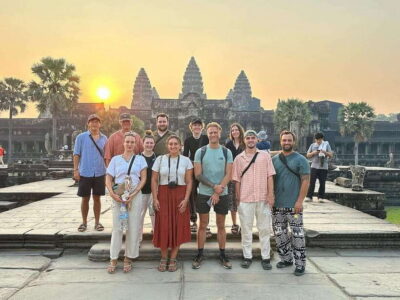
Angkor Wat: Small-Group Sunrise or Sunset Tour
Read our review →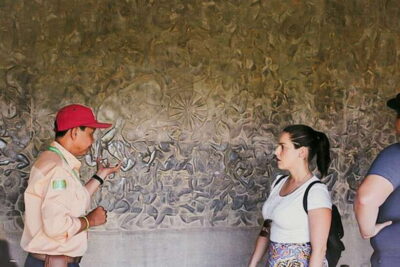
Angkor Wat 2-Day Tour with Sunrise and Sunset
Read our review →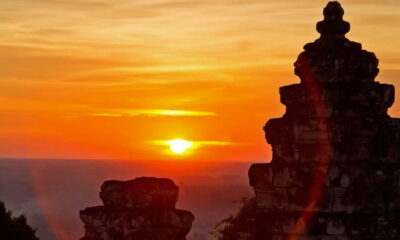
Angkor Wat Sunrise tour with Small – Group and Guide tours
Read our review →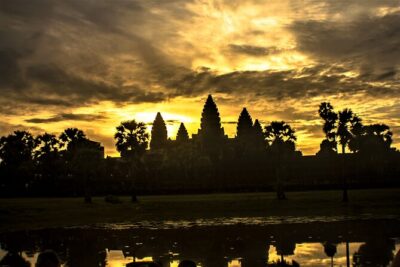
Angkor Wat Highlights and Sunrise Guided Tour from Siem Reap
Read our review →
Angkor Wat Sunset Small Group Tour with Lunch Included
Read our review →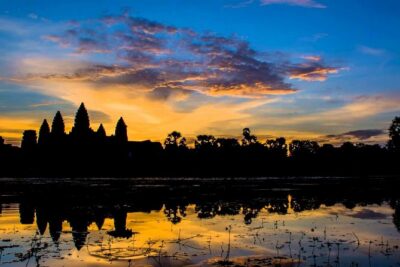
Full-Day Angkor Wat Sunrise Private Tour with Guide from Siem Reap
Read our review →Browse the lists this tour appears in