Reviewed · GUIDED
8-Hour Private Guided Tour in Siem Reap Cambodia
Angkor Wat may be the headline, but this private temple tour gives you a fuller day in the Angkor complex. You’ll see the grand ceremonial scale of Angkor Wat, Bayon’s famous stone faces, Ta Prohm’s tree-covered ruins, and quieter Ta Nei in the jungle. The guide helps connect the carvings, buildings, and spiritual ideas instead of leaving you to wander with only a map.
I like the flexible timing, which lets you shape the day around your schedule, and I like the local guide team. Guides such as Sann, Silong, and Mony have led past tours, with particular strengths in Cambodian culture, Buddhist thought, and local history. The main drawback is cost planning: the $50 tour price does not include the $37 temple admission, meals, or tips.
Key points to know before booking
- Four major temple stops: Angkor Wat, Bayon, Ta Nei, and Ta Prohm are each allotted about two hours.
- Private transport: Only your group takes part, so the day can feel more personal than a large coach tour.
- Local English-speaking guides: Sann, Silong, and Mony are among the guides associated with the tour team.
- Ta Nei adds a quieter stop: This jungle temple offers a less polished, more secluded feel than the famous monuments.
- Water is included: Drinking water is provided during the day. Some past arrangements also included cold towels, though that should not be treated as a guaranteed feature.
- Budget for the temple pass: The listed tour price is $50 per person, and one entrance ticket costs an additional $37.
A full day among Angkor’s great temples
You are not buying four unrelated photo stops here. The route gives you four different views of Angkor: the royal and religious grandeur of Angkor Wat, the faces and symbolism of Bayon, the overgrown remains of Ta Nei, and the dramatic tree roots of Ta Prohm.
The advertised duration is about six to eight hours. The planned visits add up to roughly eight hours, with two hours at each temple. That is a serious day in the heat, but it also gives you time to look closely rather than rush from one doorway to the next.
Private transport matters in this setting. Angkor is a large archaeological area, and moving between temples takes time. With only your group in the vehicle, you can discuss the pace with your guide and ask for more explanation at a particular site. The tour is also offered with pickup, though you should confirm the exact pickup arrangement when booking.
The timing is flexible. A sunrise start has been arranged for previous temple days with this company, so ask about that option if you want to see Angkor Wat in the early morning. Do not assume that the standard schedule automatically includes sunrise. Set your preferred start time in advance.
More private tours in Siem Reap:
- Full-Day Angkor Wat Sunrise Private Tour with Guide from Siem Reap
★ 5.0 · 2,920 reviews - Siem Reap: Angkor Wat Private Tuk-Tuk Tour
★ 4.9 · 2,222 reviews - Angkor Wat Private Day Tour from Siem Reap
★ 5.0 · 834 reviews
Angkor Wat, the monumental first stop
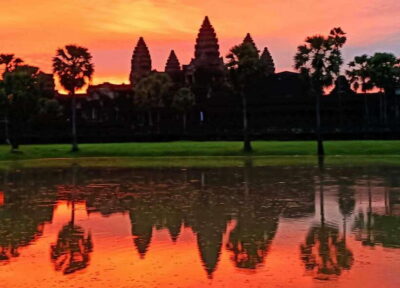
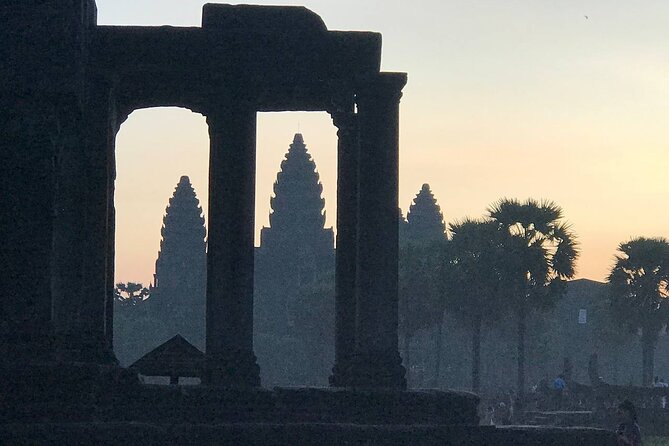
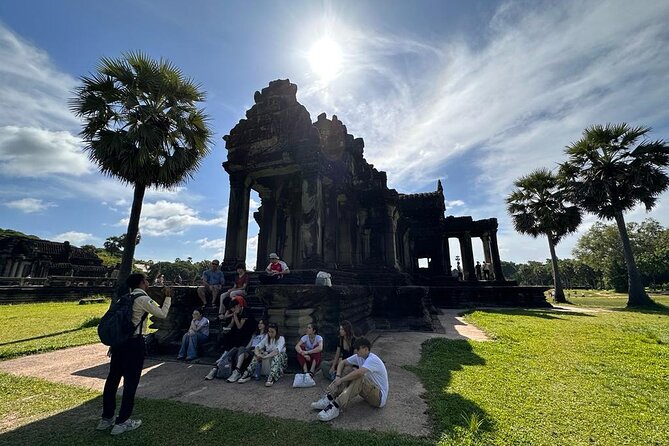
Angkor Wat is the temple that gives the entire area its name in many people’s minds, and it earns the attention. Built in the early 12th century, it was created as a Hindu temple dedicated to Vishnu and served as the capital of the Khmer Empire.
The scale is the first thing you notice. Long galleries, courtyards, towers, and carved surfaces create a sense of a planned sacred city rather than a single shrine. Your guide can help you read the layout and explain why the temple was built with such a strong sense of order and ceremony.
The two-hour allotment is useful. You can take in the main approach, walk through the galleries, study the carvings, and pause for views without treating the site as a quick backdrop for photographs. Bring a camera if you like, but a small notebook can be just as useful. There is a great deal to absorb, and a few notes can help you remember the stories later.
Angkor Wat is also the busiest and most recognizable stop on this route. Its fame is part of its power, but it means you will not get the same quiet mood found at Ta Nei. If you want the best chance of a calmer visit, ask about an early start or how the guide plans to order the temples.
The entrance ticket is not included. The listed price for one entrance ticket is $37, so add that amount to the $50 tour cost when you calculate the day. The ticket cost is significant, but the private transport and guide make more sense when you are already planning to visit several major sites.
Bayon and the famous stone faces
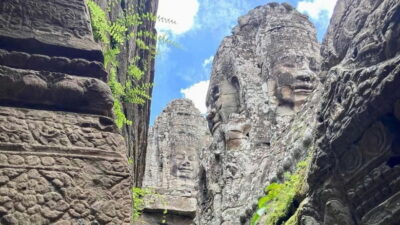
Bayon Temple provides a sharp contrast with Angkor Wat. Built at the end of the 12th century, it is described as a Hindu-Buddhist temple and is known for its large smiling stone faces.
The faces are the obvious attraction, but they are not the whole story. Bayon can feel confusing at first, with towers, narrow passages, galleries, and changing views packed into a relatively complex structure. This is where a guide earns the fee. Instead of simply pointing out the faces, your guide can explain the temple’s Buddhist ideas and place the monument within the wider Angkor area.
Allowing two hours here gives you room to look up, look inward, and study the carvings at a slower pace. The stone faces change character as you move around them. From one angle they appear calm and welcoming; from another, they seem watchful and distant.
The site can be visually intense. If you prefer a clear route and plenty of context, stay close to the guide at the beginning, then take a few minutes to explore the details that catch your eye. Guides on this team have been praised for explaining mythical stories, Cambodian culture, and Buddhist philosophy, which suits Bayon particularly well.
Ta Nei, the quieter jungle stop
Ta Nei is the most unusual stop on the itinerary because it is not one of the famous headline monuments. It is a smaller temple in a jungle setting, with trees growing around the old structure.
This is the place where you get a stronger sense of the temples as archaeological remains rather than polished sightseeing attractions. The combination of stone and vegetation gives Ta Nei a rougher, more secluded character. You can see the jungle and temple together, which makes the stop feel different from the broad ceremonial spaces of Angkor Wat.
Two hours is generous for a quieter ruin, but that is not necessarily a flaw. You will have time to look carefully at the setting, listen to your guide, and enjoy a slower pause between the larger monuments. If you are primarily interested in famous architecture, Ta Nei may seem less essential. If you like atmosphere and lesser-seen places, it may become one of the day’s most memorable stops.
The route description identifies the temple as a place many people do not see, but do not expect the same level of carved detail or grand scale found at Angkor Wat and Bayon. Ta Nei is valuable because it changes the rhythm of the day.
More guided tours in Siem Reap:
- Angkor Wat Sunrise or Sunset Tour with Guide from Siem Reap
★ 5.0 · 12,109 reviews - Siem Reap: Full-Day Angkor Wat Guided Tour with Sunset
★ 4.9 · 3,803 reviews - Angkor Wat Sunrise tour with Small – Group and Guide tours
★ 5.0 · 3,655 reviews - Angkor Wat Highlights and Sunrise Guided Tour from Siem Reap
★ 5.0 · 3,213 reviews
Ta Prohm and the power of the trees
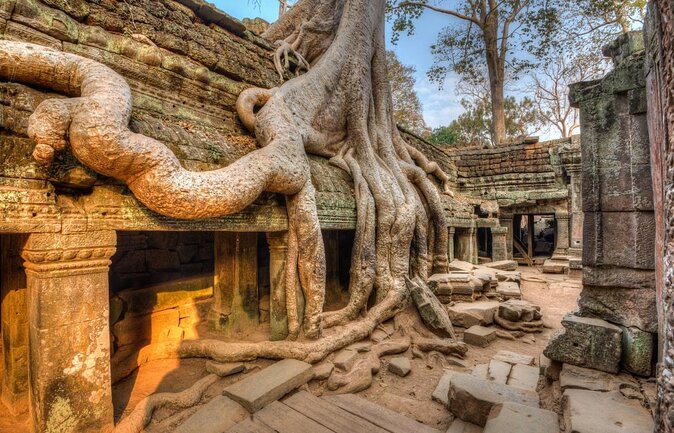
Ta Prohm is the most theatrical stop. It is the temple where enormous tree roots have grown over and around the stone, creating the image most people associate with jungle-covered Angkor ruins.
The roots are not simply decoration. They show what happens when a monumental site is left in close contact with the forest for generations. Stone corridors, towers, and roots appear to compete for space. The result is dramatic, but it also raises practical questions about conservation and the balance between preserving ruins and managing vegetation.
Ta Prohm has a connection to a Hollywood film, which adds to its fame. That connection may attract more people, but the temple remains worth seeing even if you have no interest in the movie. The mix of carved stone and tree growth is genuinely distinctive.
Your guide can help you look beyond the best-known root-covered sections. Take time to notice the layout, the galleries, and the way the temple’s surviving details fit together. A two-hour stop gives you enough time for photographs without reducing the visit to a single tree.
Among the four temples, Ta Prohm may be the easiest place to appreciate without much explanation. Still, the guide adds value by showing how it relates to Angkor’s religious and architectural traditions.
Why a private guide changes the day
Angkor can be confusing without context. The monuments are large, the names can blur together, and many carvings are easy to pass without understanding what they represent. A licensed English-speaking guide gives you a framework for the day.
The local connection is also important. The company is based in Siem Reap and uses a local team. Sann is described as having been born and raised in Siem Reap. Mony has been associated with explanations of Buddhism, while Silong has led tailored temple experiences. Your assigned guide may differ, but you can request a particular guide if availability allows.
I especially value the cultural side of the guiding. The best moments on a temple tour are often not the largest towers. They are the short explanations that connect a carving to a myth, a temple design to a belief, or an ancient monument to Cambodian life today.
The tour is private, so you do not need to match the pace of a large group. You can ask for more detail at Bayon, spend more time taking notes at Angkor Wat, or keep Ta Nei quiet and unhurried. That flexibility is one of the clearest reasons to choose this experience over a lower-priced group outing.
What the $50 price really covers
The tour costs $50 per person. That includes private transportation, a licensed English-speaking guide, drinking water, and 10 percent VAT. It does not include the temple entrance fee, breakfast, lunch, or tip money.
The extra $37 admission charge is the main budget issue. For one person, the listed tour and entrance cost come to $87 before food or gratuity. For a private day covering four major temples, that can be fair value, particularly if you are sharing the vehicle with family or friends. Group discounts are offered, though the exact reduction is not stated.
You are paying for more than a driver. The route covers a broad area, and the guide provides historical, architectural, and spiritual context throughout the day. If you are happy to study the temples on your own, a cheaper transport-only option may suit you better. If you want explanations and a flexible private schedule, the price is easier to justify.
Water is a small but useful inclusion. Siem Reap’s temple days can be tiring, so carry any additional drinks or snacks you need. Breakfast and lunch are not supplied, and the schedule is long enough that you should plan those meals around the start and finish of the tour.
Pace, comfort, and practical planning
The official operating hours are listed as 7:30 AM to 3:30 PM, from Monday through Sunday. The tour timing itself is described as flexible, so confirm the actual departure time rather than relying only on the operating hours.
The itinerary gives two hours to each temple, but that does not mean every minute is spent walking through ruins. Transport between sites, meeting your guide, and taking breaks all affect the day. The six to eight-hour estimate is realistic as a planning range, while the four two-hour visits suggest that a full eight-hour day is possible.
Wear clothing suitable for temple visits and prepare for a long day outdoors. The supplied information does not specify a dress code, so ask the operator if you want exact guidance. Comfortable walking shoes are sensible, though the tour does not publish a detailed accessibility statement.
Confirmation is normally sent at booking. If you book within one day of departure, confirmation comes as soon as possible and depends on availability. Most people can take part, and the activity is private for your group only.
Free cancellation is available if you cancel at least 24 hours before the experience begins. Changes or cancellations made less than 24 hours ahead are not accepted for a refund.
Who will get the most from this tour
This tour suits you if you want the major Angkor temples in one organized day and prefer a private guide to a large group. It is especially useful for first-time visitors who want help understanding the carvings, religious ideas, and history rather than simply collecting photographs.
It also works well for friends or families who want control over the pace. The flexible schedule and private transport make it easier to discuss what matters most to your group.
You may want a different plan if you dislike long temple days or prefer a very slow visit to one or two monuments. Four temples, each with a planned two-hour stop, is a full program. Ta Nei adds atmosphere, but it also means less time could be available for lingering at Angkor Wat or Ta Prohm if the day runs late.
If sunrise is important to you, ask about it before booking. Sunrise arrangements have been made with the tour team, but the standard information does not promise that every departure begins before dawn.
Should you book the Angkor temple tour?
I would choose this tour if you want a clear introduction to Angkor with a local guide, private transport, and four contrasting temples in one day. The strongest reasons are the guide’s cultural context, the chance to include Ta Nei, and the flexibility that comes with a private group.
Before you commit, add the $37 temple ticket, decide how you will handle breakfast and lunch, and confirm your preferred start time. Ask which guide is assigned if you have heard good things about Sann, Silong, or Mony. Book it if you value explanation and convenience. Skip it if you want a cheaper, self-guided visit or a much slower schedule.
FAQ
How long does the tour last?
The experience lasts approximately six to eight hours. The itinerary allows about two hours at each of four temples, so a full eight-hour day is possible.
Which temples are included?
The tour visits Angkor Wat, Bayon Temple, Ta Nei Temple, and Ta Prohm.
Is the temple entrance fee included?
No. The temple admission ticket is listed separately at $37 for one entrance ticket.
What does the $50 tour price include?
The price includes private transportation, a licensed English-speaking guide, drinking water, and 10 percent VAT.
Are meals included?
No. Breakfast and lunch are not included in the tour price.
Is the tour private?
Yes. Only your group participates in the private tour or activity.
Can the tour start at a flexible time?
Yes. The timing can be based on your schedule, but you should tell the operator your preferred time in advance.
Is cancellation free?
You can cancel for a full refund if you do so at least 24 hours before the experience start time. Cancellations or changes made less than 24 hours before the start are not accepted for a refund.
Just added around Siem Reap
- Ultimate Sunrise to Angkor Wat, Angkor Thom and Bayon Temple★ 5.0 · 3 reviews
- Full-Day Private Tour of Angkor Wat with Pick Up★ 5.0 · 12 reviews
- Trekking Tour at Phnom Kulen National Park from Siem Reap★ 5.0 · 3 reviews
- Twilight Tastes of Siem Reap Include Dinner★ 5.0 · 13 reviews
- Siem Reap City Tour with War Museum and Killing Field★ 5.0 · 27 reviews
- Private Day Trip to Angkor Temples with Expert Guide★ 5.0 · 4 reviews
- Waterfall & River of 1000 Siva Linga- Kulen Mountain Private Tour★ 5.0 · 3 reviews
- Private Two Days Siem Reap Temples Discovery Guided Tour★ 5.0 · 7 reviews
Guided, compared.
Angkor Wat Sunrise or Sunset Tour with Guide from Siem Reap
Read our review →
Angkor Wat Sunrise tour with Small – Group and Guide tours
Read our review →
Angkor Wat Highlights and Sunrise Guided Tour from Siem Reap
Read our review →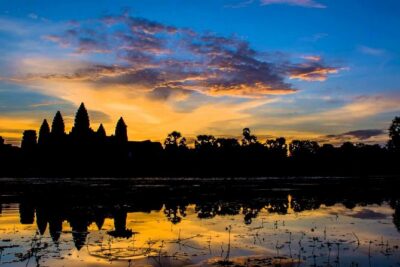
Full-Day Angkor Wat Sunrise Private Tour with Guide from Siem Reap
Read our review →